Category Archives: Local News

Custer County recycling manager offers reminders on what can be recycled

Custer County Recycling Manager Kelly Flynn is reminding area residents about some simple ways they can help make the local recycling program more effective.

Flynn recently discussed recycling on the KCNI/KBBN Public Affairs program, touching on both the importance of recycling and some common mistakes that can create problems for the program.

Flynn says the Custer County Recycling Center will continue operating for now, with the current lease of the building running through at least February 2028. In the meantime, representatives from communities across the county have recently met to discuss ways to help sustain recycling in the area, with additional meetings expected.

Flynn says recycling provides an alternative to sending material to the landfill, particularly as the cost of trash disposal continues to increase. He also offered several reminders about what residents should and should not put into recycling trailers.

Paper products that can be recycled include newspapers, magazines, phone books, paperbacks, office paper, junk mail, shredded paper and paperboard boxes, such as cereal, pop and beer boxes. Cardboard is also collected at several locations including Broken Bow, Callaway, Ansley and Burwell, giving residents in those communities an opportunity to recycle cardboard without having to bring it to the main center in Broken Bow.

Flynn emphasized that recyclable materials need to be clean. When putting cardboard in a recycling trailer, items such as Styrofoam and plastic packaging should be removed rather than being placed inside the cardboard box.

Contaminated material can create problems when the recycled products are sold to markets. Flynn says too much unwanted material can result in lower prices or potentially cause a market to stop accepting the material altogether.

The same principle applies to paper. Used paper plates with food on them, for example, should be placed in the trash rather than the recycling.

Plastic recycling is another area where residents can easily become confused. Number one and number two plastic bottles are accepted by the county, but that doesn’t mean that every plastic item with a number one or number two is recyclable.

Flynn says the plastic needs to be a bottle that previously had a lid. Clear plastic containers used for items such as blueberries or spinach may carry a number one designation but are not accepted for recycling.

Plastic bottles can be recycled with their caps, although Flynn offered a seasonal reminder concerning milk jugs. During warmer weather, he recommends removing the cap from milk jugs before putting them in the recycling because any remaining liquid or residue can lead to mold and unpleasant odors.

Tin cans are also accepted and should be rinsed, although labels can remain attached. Aluminum cans can be placed in the recycling trailers as well, although residents also have the option of taking them directly to Myers Iron to be sold.

Flynn says small steps by residents can make a significant difference in keeping recyclable material clean and usable.

The Custer County recycling program currently serves six counties and 14 communities and has 22 trailers throughout the area. Since its start in 1995, over 18,000 tons of material have been recycled and kept out of landfills as of the start of September.

Listen to Flynn’s full conversation with KCNI/KBBN’s Brent Apperson on Public Affairs here:
Custer County Planning Commission advances data center regulations to County Supervisors

BROKEN BOW, Neb.— The Custer County Planning Commission has completed its work on proposed regulations for data centers, unanimously voting Wednesday to recommend the regulations to the Custer County Board of Supervisors for consideration.

The vote came during a public hearing Wednesday afternoon on the top floor of the Custer County Courthouse. Commission members Mike Kozeal, Neil Ostrand, and Rod Baillie were absent. All other members were present for the meeting.

The regulations are the result of several months of research and discussion during a six month county moratorium on data centers and related facilities that expires at the end of September.

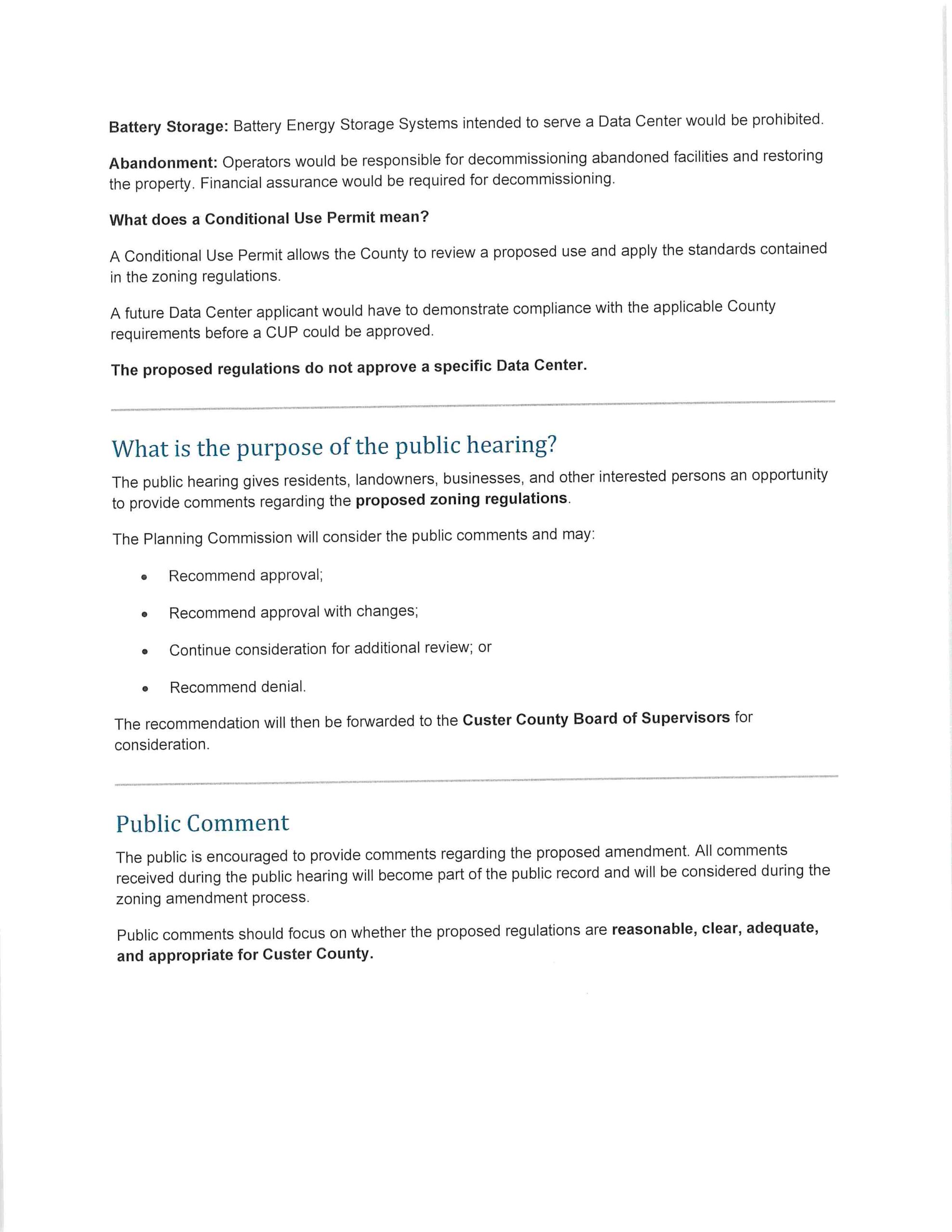
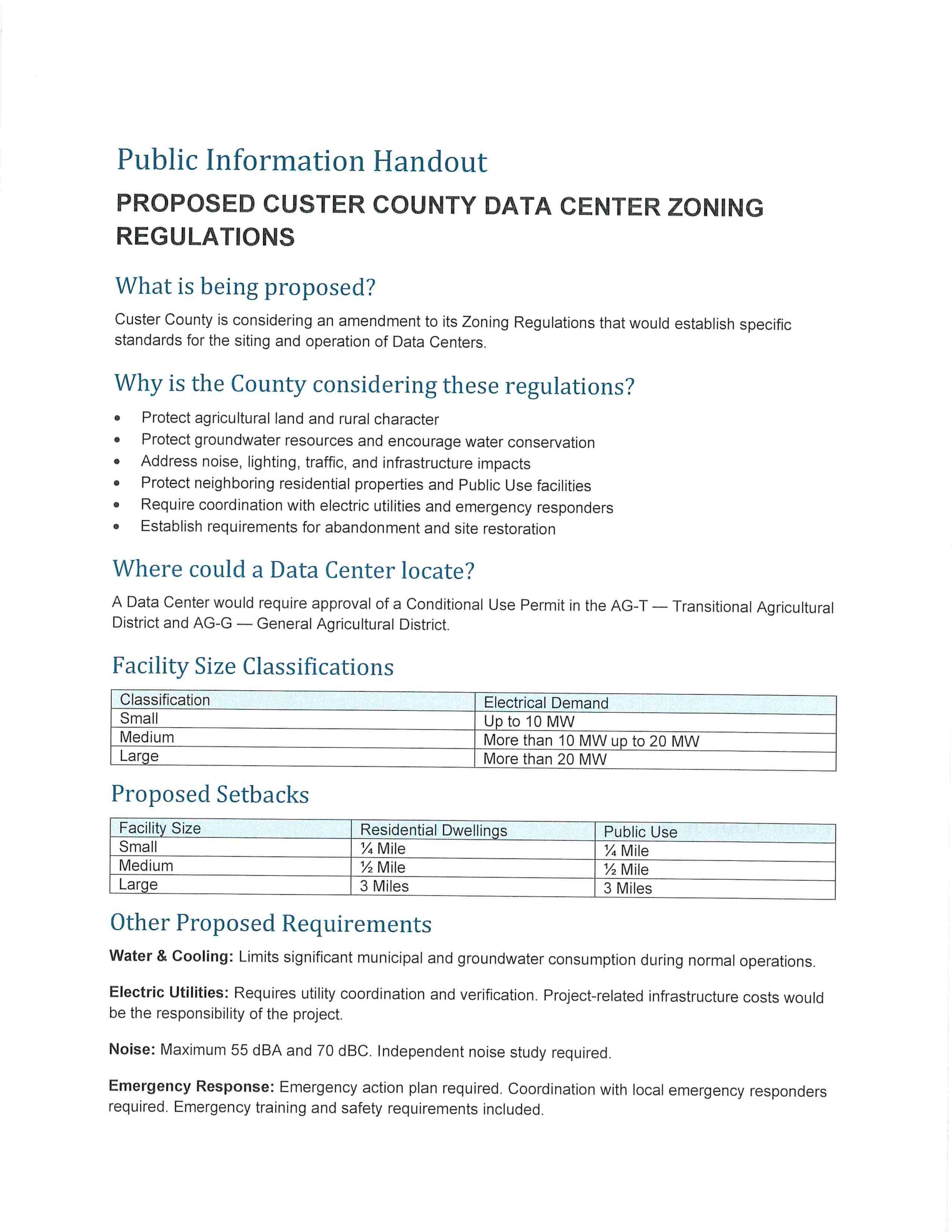
View a ‘public information handout’ on the zoning regulations for data centers at the end of this story. You can also view the full regulations document here: Custer County Data Center Regulations 9.23.26.

Custer County Zoning Administrator Darci Tibbs reviewed the process that led to the proposed regulations, saying the Planning Commission and Board of Supervisors have toured smaller data center facilities using different cooling technologies, heard from people involved in the industry and researched regulations adopted by other communities.

The commission’s work has focused on issues including water use, cooling systems, noise, electrical demand, emergency response, setbacks and what happens if a facility is abandoned.

A couple of final changes

One of the first issues addressed Wednesday was the language dealing with abandonment and decommissioning.

The commission considered three versions of the provision before unanimously selecting language that says a facility would be considered abandoned if data processing operations cease for 12 consecutive months. Temporary, intermittent, testing, maintenance, emergency or nominal operations would not interrupt or reset that 12-month period.

If a facility is abandoned, the site would have to be decommissioned and returned to a compatible state consistent with surrounding property and the approved decommissioning plan.

The commission also unanimously approved removing references to an irrevocable letter of credit in two portions of the decommissioning requirements.

Another addition came as a result of a recently passed state law concerning community benefits agreements for data centers 10 megawatts or larger.

The regulations will now state that data centers with a peak electricity demand of at least 10 megawatts must enter into a community benefits agreement as required by state law. The county could also require such an agreement as a condition of approval for facilities below 10 megawatts.

The agreement could address things such as road and infrastructure improvements, emergency response funding, public safety training, utility impacts, water and wastewater monitoring, environmental monitoring and other project-related impacts.

Public raises concerns

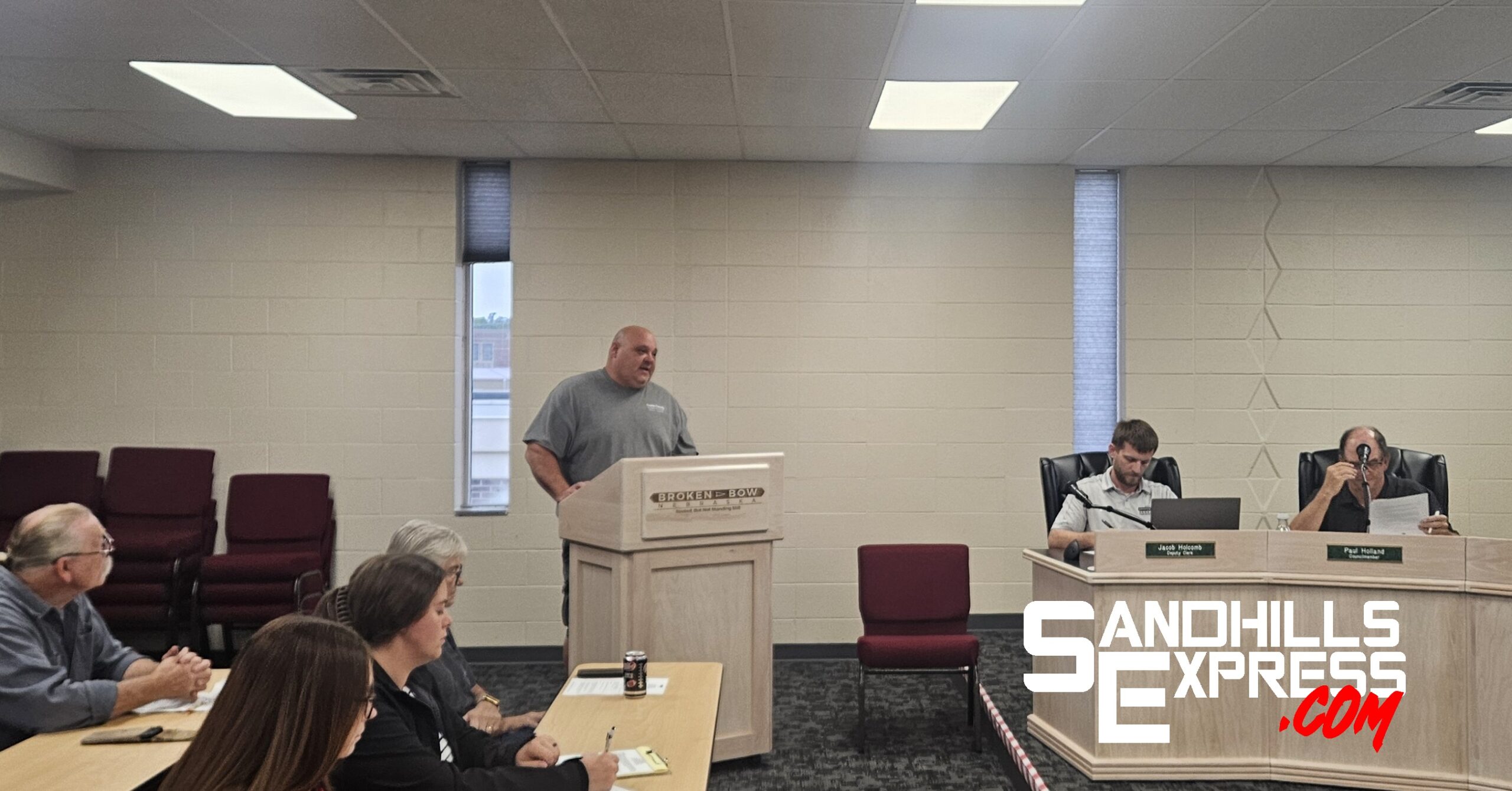
Three members of the public addressed the commission during the hearing.

Cole Tierney said he believes caution is appropriate because of the rapidly changing nature of data center and artificial intelligence technology. He pointed to previous periods of rapid technological and economic growth and said that unintended consequences sometimes do not become apparent until years later.

Tierney also asked the commission to consider a five mile setback from residential dwellings for data centers of any size, to which commission members responded would effectively prevent a data center from locating anywhere in the county. Tierney’s quick confirmation that that was his point brought chuckles across the room from those in attendance.

Kevin Cooksley thanked the commission for its work but raised questions about how liquid from closed loop cooling systems would be handled when expelled. It was stated later in the meeting that a common practice is for the fluid to be pumped into containers and recycled rather than discharged into the ground or nearby bodies of water.

Cooksley expressed concerns about the amount of electricity a data center could require from Custer Public Power or Nebraska Public Power District, particularly during periods when agricultural irrigation already creates significant electrical demand.

The commission noted that the proposed regulations include provisions allowing the local power utility to interrupt or reduce a data center’s electrical service when necessary, with irrigation given priority during load control situations.

Cooksley said the county’s water and electrical resources are among the things making the area attractive to data center developers and that they should be protected as development is considered.

“Our water and our power is something that we should really, really stringently safeguard,” said Cooksley.

Deborah Miller also raised concerns about water use from the Ogallala Aquifer, citing how it is already ‘going down’ and its importance for citizens and irrigation.

Commission members pointed to the difference between closed loop systems and other large water users, including irrigation, as one reason they believe the proposed requirements would substantially limit water consumption by data centers.

Regulations move to supervisors

Following the public comments and additional discussion, the commission unanimously approved a motion to send the recommended regulations to the Custer County Board of Supervisors for consideration.

Click here to view the full data center regulations document

Other items from Wednesday’s meeting

  • The commission unanimously recommended the Board of Supervisors adopt a 12 month moratorium on battery energy storage while a similar process of research used on data centers is conducted. It was explained that battery energy storage systems can range from smaller systems serving individual properties to large commercial or utility scale facilities covering multiple acres and connecting directly to the electrical grid. Fire safety, battery disposal, and the combustibility of lithium-ion battery systems were among concerns mentioned.
  • Tibbs stated that by the next meeting she would have information to present that would help the board determine if they would like to address updating the comprehensive plan themselves or hire a consultant. It was said that the comprehensive plan had not had changes made to it in some time and that it needed to align better with zoning regulations that had been made since its last revision.
  • Going forward the board will look into LB663’s effect on conditional use permits and the language county’s use for them. More specifically, ‘shot clock’ language and definitions on continuing education hours for commission members.

The next Custer County Planning Commission meeting will be held next quarter or as needed. No specific date was set.

Discussions Continue on In-Town Livestock; Municipal Building Elevator Takes a Step Forward

The Broken Bow City Council met in regular session Tuesday evening, September 22. Mayor Rod Sonnichsen called the meeting to order in the Broken Bow Municipal Building at 6:00 PM. Council member Joe Wamsley was the single absence from the meeting.

In-town Animals Generate More Discussion

The bulk of the meeting was spent in open discussion of the proposed Ordinance 1323 regulating livestock and poultry within city limits. City Administrator Dave Schmidt presented an updated version showing changes made in response to comments in the prior meeting, as well as conversations he has had with Broken Bow citizens the past two weeks.

Updates include specified pen sizes for specific breeds of livestock, as well as the ability to retain a grandfathered status if a property is sold.

Broken Bow resident Steve Weatherly brought a number of additional recommendations for the council to consider. Among these were a requirement to notify neighbors as a part of the approval process to have temporary animals for 4H or FFA, and to closely regulate the total number of animals that could be kept in in-town pens. Weatherly also noted that some fowl allowed in the ordinance – geese and guinea fowl both make quite a bit of noise, which may run afoul of nuisance provisions.

Citing concerns about other nuisance issues, in particular runoff from animal waste, Weatherly stated, “I think Broken Bow is a up and coming town, and this makes it look like we don’t want that when … that drains into a city street. Some of the way it can be addressed is to limit numbers to where it can be easily managed. If you’re working with a wheelbarrow and a pitchfork, it’s different.”

Resident Taylor Gonzalez noted she keeps a pair of dairy goats and a covey of quail in town to help feed her family, and was concerned that limiting her flock to 6 birds would not allow for a sufficient number of the smaller eggs for that purpose. Gonzalez asked if other safety, abuse or neglect laws could also be used to address nuisance properties, noting that limiting numbers does not prevent people from not taking care of the animals they have.

Schmidt noted that nuisance laws are difficult to enforce long-term, as they may temporarily address waste issues, but not necessarily the presence of the animals creating more waste.

Sonnichsen stated the city is trying to meeting in the middle, with a number of complications, including several legal issues still to resolved. The Council requested a finalized ordinance be presented at the next meeting October 13th, but all felt a full three readings of any ordinance would be in order.

In the meantime, Schmidt encourages anyone with comments, concerns or suggestions to contact the city offices, even dropping in for a conversation in person.

Other Council Actions

Custer County Emergency Manager Mark Rempe addresses the Broken Bow City Council (Click to enlarge)

At the beginning of the meeting, Custer County Emergency Manager Mark Rempe reported that the emergency dispatch center would soon be moving from its current location at the Police and Sheriff’s offices on South B Street to larger accommodations in the Custer County Courthouse.

Rempe stated this would allow for an upgrade to communications equipment used for emergency and law enforcement activities, as well as a full third station for an additional dispatcher to operate from. The move and upgrades are to be funded by Custer County and the Communications Department, with no cost to the City.

The Council approved designation of two new handicap parking spots. The first will be on the west side of South 10th Avenue, between the old Carnegie Library building (the Steffens Law offices) and the Custer County Chief building. The second will be on the north side of South D Street, in front of Legends Neighborhood Grill.

A new shoulder patch was approved for Broken Bow Police Officers. Police Chief Chris Anderson indicated his team had been working on a new patch for some time, and that the new insignia was designed entirely in-house, with no city money spent on the project to this point.

The current patch (left) and the newly- approved patch (right) for the Broken Bow Police Department

The Council approved a contract with JEO Consulting to spend $100,000 from funds left in the 2025-2026 budget on concept and design planning to update the entry lobby of the Municipal Building, including the installation of an elevator. Schmidt noted the project would be stretched over the next couple of years to minimize impact on budgeting and tax ask.

Ending the meeting, Mayor Sonnichsen and the Council praised the recent bicycle safety event on the square, calling it a huge success and congratulating the Broken Bow Area Rotary and Jeremy Walton in particular for their efforts. Sonnichsen stated at least 135 people attended the first of three hours of the event, noting, “I have noticed all the new bicycle helmets. They are in use – I have seen several, which is a great thing.”

The Broken Bow City Council adjourned at 6:40 PM. The next meeting of the City Council is scheduled for Tuesday, October 13 at 6:00 PM in the Broken Bow Municipal Building.

Public hearings for data center regulations, battery energy storage to be held during planning commission meeting

The Custer County Planning Commission will have a meeting at the Custer County Courthouse in Broken Bow inside the supervisors room on Wednesday starting at 1:30 PM.

Recap of the August 19 Planning Commission meeting

Following roll call and approval of the August 19 meeting minutes, communication items include a comprehensive plan webinar and a virtual fall workshop.

Two public hearings will happen during Wednesday’s meeting. The first, set for 1:45 PM, is regarding data center regulations.

A six month moratorium on data centers and related tech facilities runs through the end of September. During last month’s meeting, regulations reviewed included size and location, water use, cooling systems, noise, electrical demand, emergency response, security, and abandonment or decommissioning.

It’s expected that a revised working draft reflecting changes discussed at that meeting to be prepared for Wednesday’s meeting. Once the Planning Commission is satisfied with a draft, it will be passed to the Custer County Board of Supervisors for consideration.

A public hearing on battery energy storage, on which a 12 month moratorium was placed at last month’s meeting, will be held at 2:00 PM.

In old business, the commission will give an update and direction as to the comprehensive plan.

In new business, an amendment to the Custer County Zoning regulations will be considered regarding state legislative updates to conditional use permits.

The agenda for Wednesday’s meeting is kept continuously current and open for public inspection in the office of the zoning department.

Livestock, poultry, handicap stalls, new police patches among topics for Broken Bow City Council on Tuesday

Broken Bow City Council will meet tonight starting at 6 PM in the Municipal Building on South 10th Avenue.

Following roll call, the pledge of allegiance, and consent agenda business, council will dive into ‘other communication’ items starting with an update regarding Custer County Communications changes and new equipment. The visit from Custer County Emergency Manager Mark Rempe is expected to detail the impact on the city and its departments.

Also in ‘other communication’, discussions will continue on an ordinance regarding livestock and poultry in town. At the meeting earlier this month, the subject was brought up following concerns with nuisance livestock in town. A proposed ordinance would create a prohibition of most livestock in Broken Bow, with exceptions for existing processing facilities, animals being raised for 4-H and FFA projects, and a flock of up to 6 chickens or ducks (but no roosters). Properties with existing livestock may be grandfathered in as well, provided the animals do not create a nuisance with noise or waste.

The current patch (left) and the proposed updated patch (right) for the Broken Bow Police Department

Two ordinances regarding designating new handicap parking stalls are the first items in ‘new business’ tonight. One location is on the west side of South 10th Avenue, being the first parking stall North of the South C street crosswalk. The other is on the north side of South D Street, the first stall East of South 9th Avenue in front of Legends Neighborhood Grill. Public hearings, a possible waiving of three readings, and consideration by council will be held for each.

A resolution will be considered by council to update the official shoulder patch for the Broken Bow Police Department. The new patch, if approved, would feature a stone arrowhead crossed by a golden broken bow. Behind the arrowhead is the outline of the State of Nebraska with a rising sun and blue river-like bands.

To round out tonight’s meeting, an agreement with JEO Consulting Group will be considered for the ‘Broken Bow City Hall Elevator and Reception Area Improvements’ project. If approved, $100,000 would be paid to JEO as an upfront retainer for the project, with $40,000 going to programming and preliminary design services and the remaining $60,000 intended for continuing design services.

View the full city council packet for tonight’s meeting here: 2026.09.22-Council-Packet

Broken Bow school board approves tax request, 26-27 budget

The Broken Bow school board met Monday night starting at 5:30 PM in the board room at the school. All members were present at roll call and for opening procedure items. Colby Fisher departed shortly after.

Michael Tierney was welcomed to the board’s open spot by his now fellow members following his reading of procedural statements.

During district accolades, Superintendent Darren Tobey reported that the school had three ‘Believers and Achievers’ nominations (Drew Ellis, McKenna Jacobsen, and Madden Kleeb). The award recognizes students that excel in academics, activities, leadership, and service to their school and community. Finalists will be determined by the NSAA.

Tobey also presented the board with documents he presented at the recent RTM National Superintendents Forum in Houston. He reported that the district’s ‘short cycle non negotiables’, a system in place to pre-test, teach lessons, check in, review, assess, and re-teach, is similar to what’s used in Houston (although on a much smaller scale).

Finally, Tobey said that walkthroughs with administrators and teachers to observe in different classrooms and give building points to each other started today and will continue tomorrow. He added that the district’s ‘compete and complete’ program for middle schoolers and high schoolers has been working well to start the year. The program has students with incomplete work or assignments bring their lunch to a designated time during lunchtime to work on getting them completed. Tobey said the program is designed to indicate that if students are going to participate in activities, they need to work to get their missing work done.

Policy 5045 (View here), regarding student fees, was approved by the board. The policy sets fees charged by the district, the maximum dollar amount charged by the district for items needed to participate, and also defines what the school will provide in each instance.

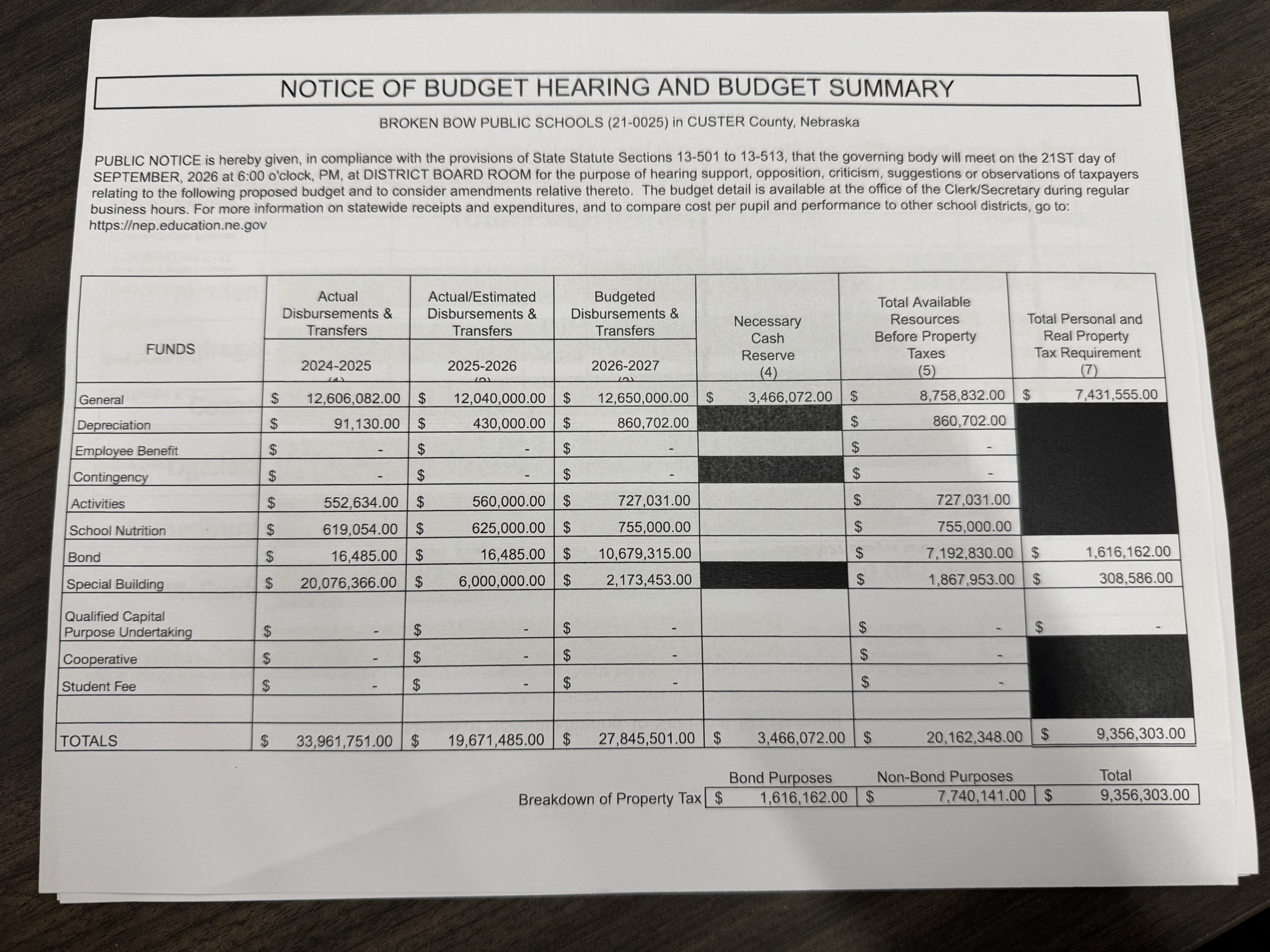
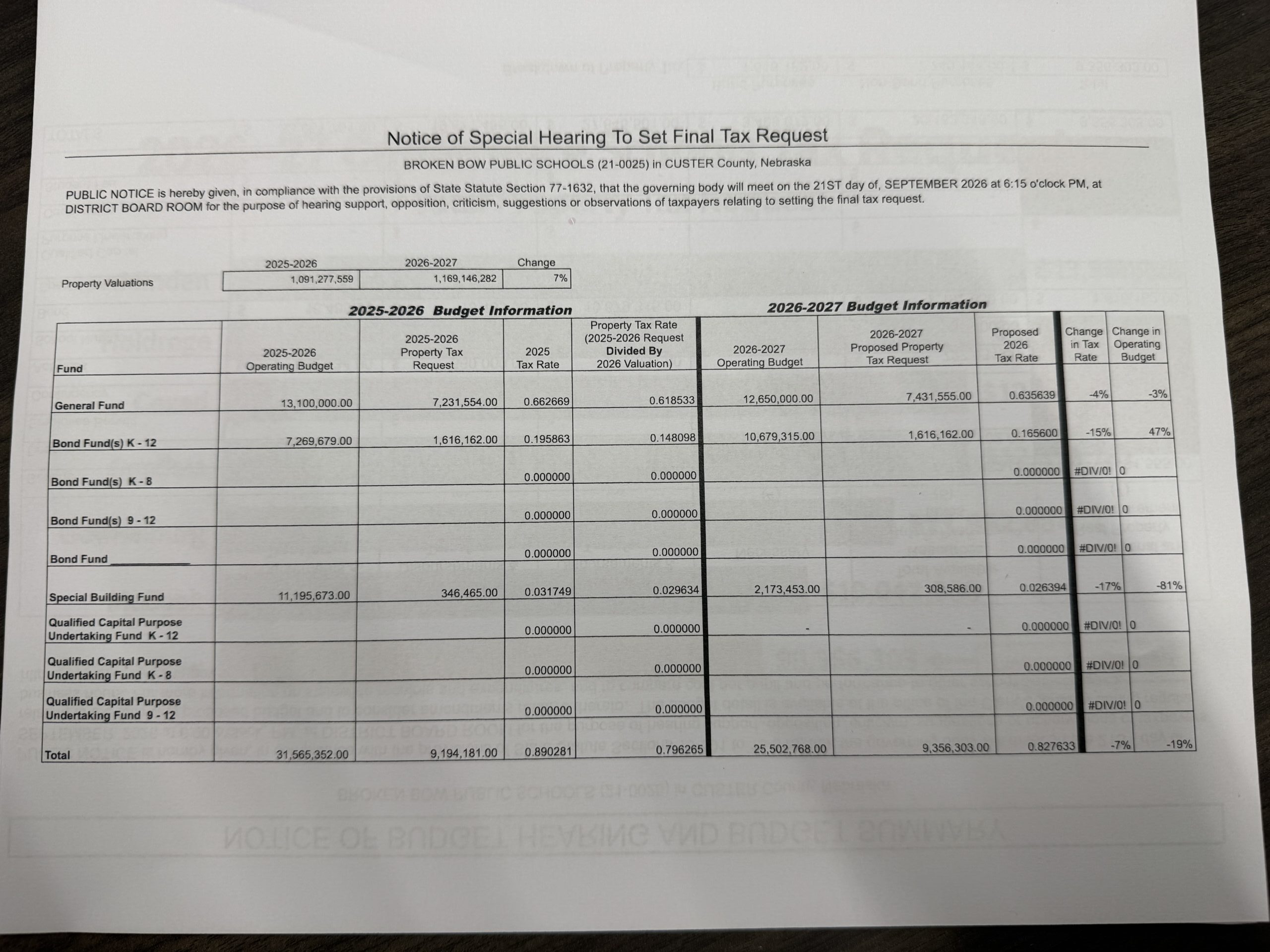
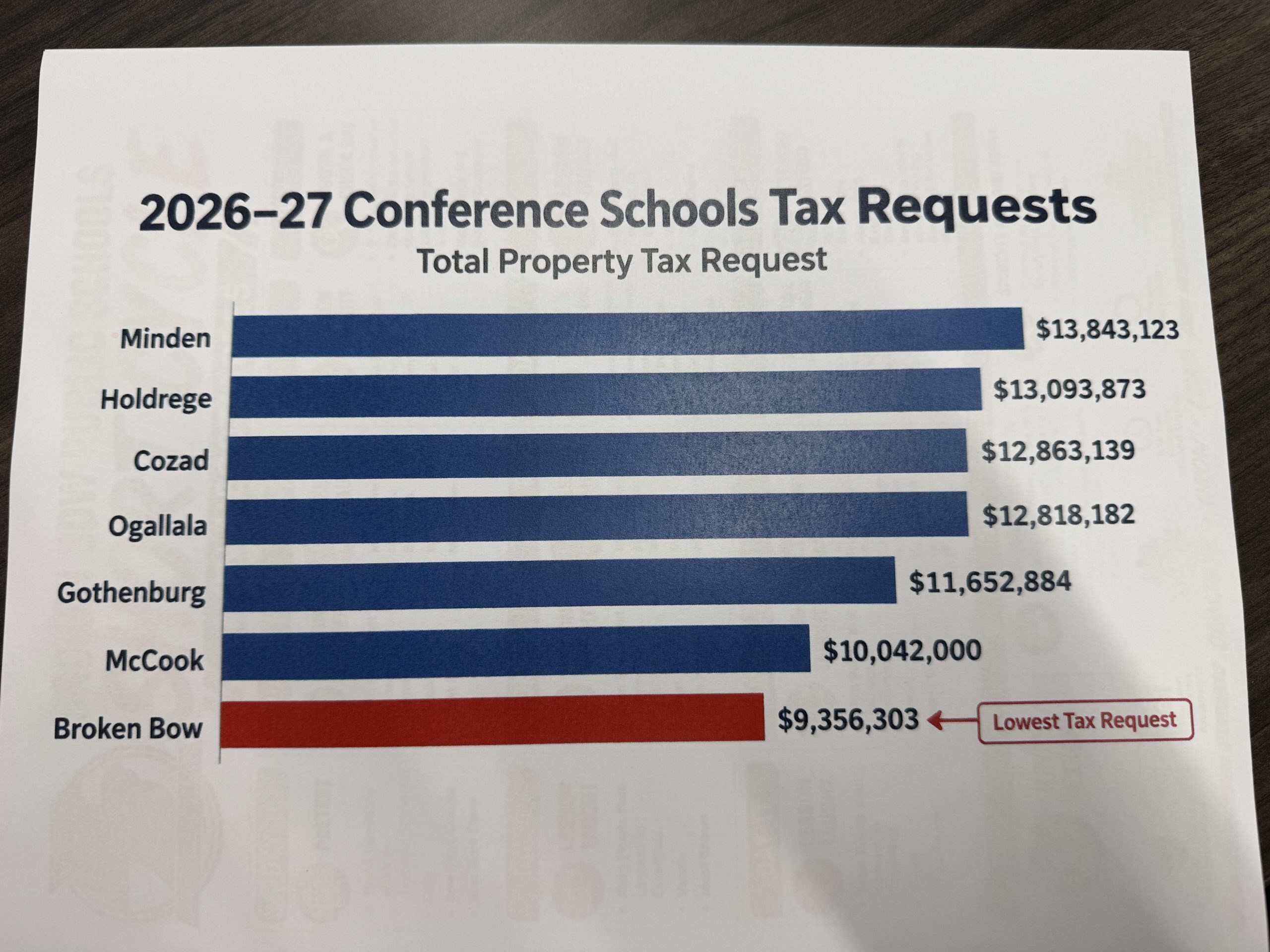
To round out Monday’s meeting, the board present unanimously approved the district’s budget and tax request. Totaling $9,356,303, the increase of tax request comes in at 1.76%. $1,616,162 of that is noted to be for bond purposes. The school’s total operating budget for 2026-2027 that includes the general fund, bond fund, and special building funds is $25,502,768. It was noted that the bond fund number in the operating budget is higher this year due to the paying off of the North Park bond later this year.

Semi vs vehicle accident sends one to the hospital

The Broken Bow Police Department (BBPD) responded to a two vehicle accident between a semi truck and a Ford Escape just before 11 AM on Monday, resulting in one party being transported to the hospital for evaluation.

An initial investigation shows that a silver Ford Escape was pulling out of the Ranchland Ford dealership and turning left onto East South E Street (Highway 2). A semi truck traveling eastbound on Highway 2 struck the driver’s side front fender of the Escape with its passenger side as the driver tried to avoid the vehicle.

The Escape driver was transported for evaluation to Melham Medical Center. The extent of injuries was not immediately available. The driver of the semi was not injured.

BBPD thanked the Custer County Sheriff’s Office, Broken Bow Volunteer Fire Department, Broken Bow Ambulance Service, and Broken Bow City Streets Department for their help at the scene.

UNK Band Day Brings Music, Marching to Downtown Kearney

KEARNEY – The beat of drums and sound of brass echoed through downtown Kearney on Saturday as student musicians took center stage during a traditional fall event.

A total of 32 middle and high school marching bands from across the state joined the University of Nebraska at Kearney for the 67th annual UNK Band Day Parade.

A long-standing staple of the fall marching season, UNK Band Day is both a celebration of music and competition. It serves as preparation for the Harvest of Harmony Parade and Field Competition, scheduled for Oct. 3 in Grand Island.

For the 10th straight year, Kearney High School won the sweepstakes trophy awarded to the top overall band. The Bearcats also received the outstanding drum line and color guard awards.

Other first-place honors went to Gering in Class A, Holdrege in Class B, Amherst in Class C, Parkview Christian in Class D and Lexington in the middle school division.  The Arcadia High School Band was honored as the runner-up in the Class D division.

Broken Bow High School Band at UNK Band Day – click to enlarge (Photo by Dean Ringlein)

UNK Band Day Results

 Sweepstakes Trophy

Kearney High School

Outstanding Drum Line

Kearney High School

Outstanding Color Guard

Kearney High School

 Class AA

1st – Kearney High School

2nd – Grand Island Senior High

3rd – Columbus High School

Class A

1st – Gering

Class B

1st – Holdrege

2nd – Grand Island Central Catholic

3rd – Kearney Catholic

 Class C

Loup City High School Band performs at UNK Band Day (click to enlarge) Photo by Dean Ringlein

1st – Amherst

2nd – Doniphan-Trumbull

3rd – Ravenna

Class D

1st – Parkview Christian

2nd – Arcadia

3rd – Wilcox-Hildreth

Middle School

1st – Lexington

2nd – Ogallala

3rd – Faith Christian

Teammates ‘Runza Day’ is Tuesday, will benefit Broken Bow, Anselmo-Merna, Callaway

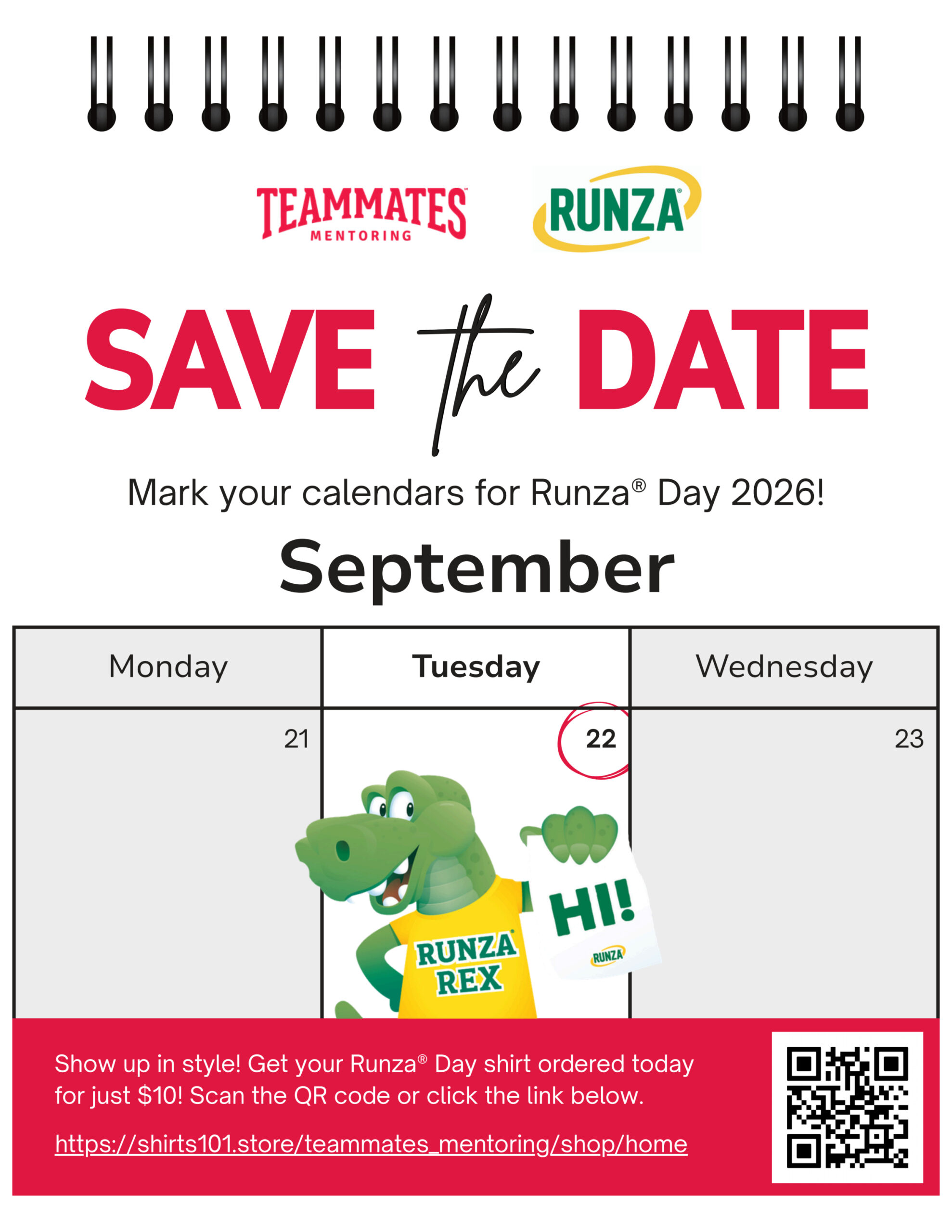
Local Teammates chapters and the Runza location in Broken Bow are teaming up on Tuesday (September 22) for ‘Teammates Day’, where a portion of purchases made through the day will support the program.

Chapters in Broken Bow, Anselmo-Merna, and Callaway will benefit from the partnership and Teammates board members and mentors from those local chapters will be at the Broken Bow Runza location through the day helping in the restaurant.

Teammates is a mentorship program where mentors and mentees connect weekly for between 30 and 60 minutes during the school day. It was founded in 1991 by Coach Tom Osborne and his wife Nancy when 22 Husker football players mentored middle school students in Lincoln. Today, there are chapters in more than six states.

Litchfield’s Janet Fletcher first recipient of remote pulmonary artery pressure monitoring technology

KEARNEY, Neb.— CHI Health Good Samaritan is enhancing cardiac care for the region with the introduction of remote pulmonary artery pressure monitoring, leading-edge technology designed to help patients manage heart failure from the comfort of their own homes.

The hospital’s heart team recently completed its inaugural procedure in the cardiac catheterization lab, with Litchfield resident Janet Fletcher as the first recipient.

“The procedure itself was so quick and easy, and I’m just so thankful. Having this technology locally is going to be life-changing for me. It provides such peace of mind knowing my team is keeping a close eye on my heart failure,” says Fletcher.

The technology uses a sensor roughly the size of a paperclip, which is implanted in the pulmonary artery. Once in place, the device wirelessly transmits daily blood pressure readings to the Fletcher’s clinical team, allowing for proactive, remote management of heart failure symptoms.

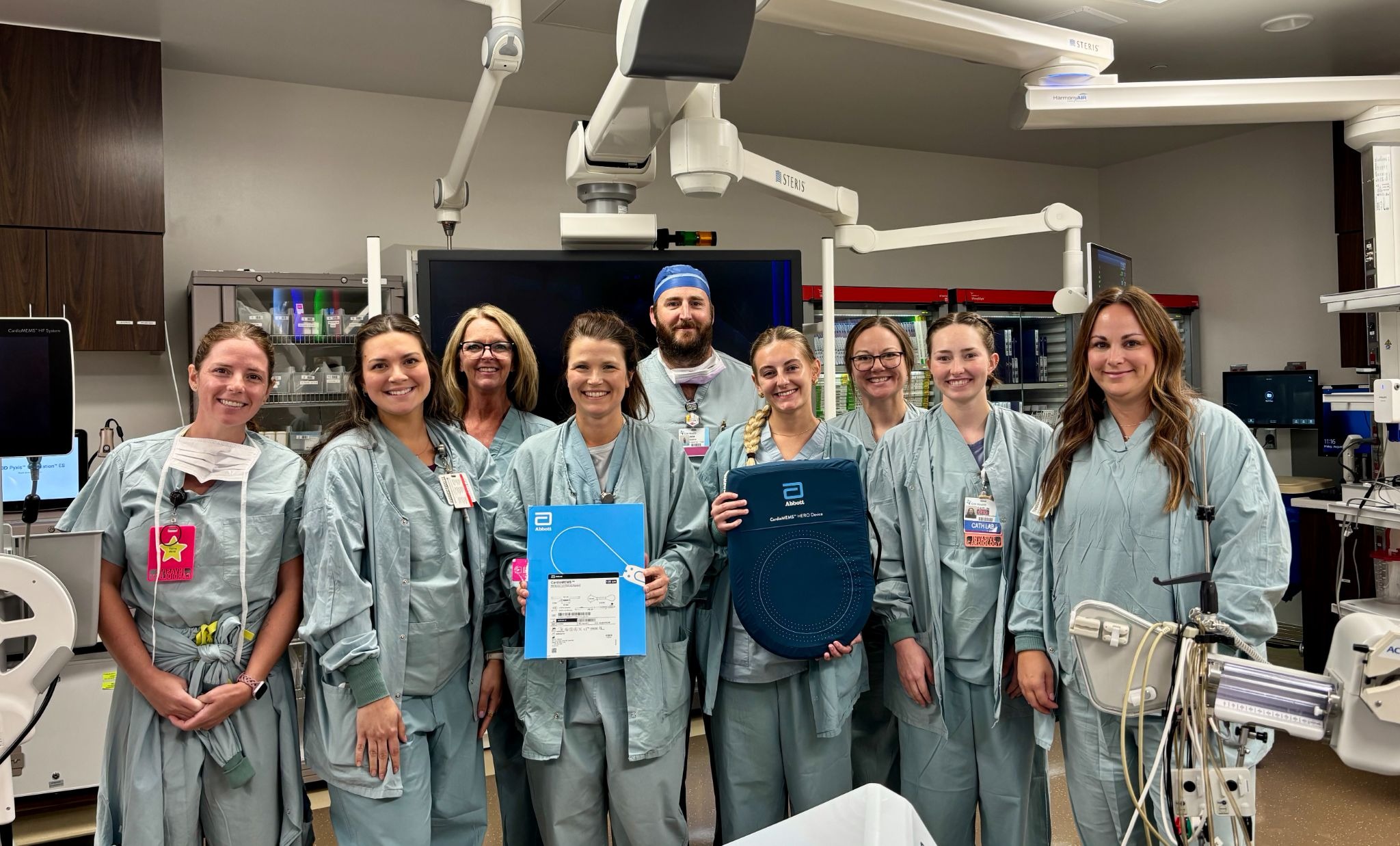
Members of the Good Samaritan Cath Lab team present the remote pulmonary artery pressure monitoring system recently launched at the hospital. The tiny sensor, roughly the size of a paperclip (shown in the container on the left), was implanted into the pulmonary artery of first patient Janet Fletcher. When Fletcher lies back on the specialized pillow (held by team members on the right), pressure changes are transmitted immediately to her care team. This real-time data helps prevent additional heart damage and hospital readmissions, enhancing patient quality of life and clinical outcomes.

“It’s a game-changer for our patients,” says Kirby Knuth, APRN, CHI Health Clinic Health Institute (Kearney). “By monitoring pressure changes in real-time, we can identify signs of worsening heart failure before the patient decompensates enough to feel symptoms. Catching it early allows us to adjust treatment plans and prevent the need for hospital stays.”

Heart failure impairs the heart’s ability to circulate blood and oxygen effectively, leading to progressive cardiovascular damage and high rates of hospital readmission—with nearly 25% of patients returning to the hospital within 30 days. Standard monitoring methods, such as tracking weight and blood pressure, frequently fail to detect early warnings of worsening health. With remote pulmonary artery pressure monitoring, clinical teams can identify changes in real-time—prior to the onset of physical symptoms like weight gain or shortness of breath—preventing further heart damage, re-hospitalization and improving patient outcomes and quality of life.