OMAHA — The City of Omaha is poised to make what Mayor John Ewing Jr. called its “single largest investment” in affordable housing as part of his effort to close the gap between the “haves and have-nots.”
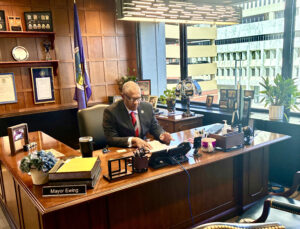
Seed money would come, the mayor and his team said, via the sale of bonds to be repaid by anticipated tax-increment financing revenue tied to the streetcar project.
The city’s plan for the controversial streetcar already had called for some TIF-related proceeds to help create affordable housing — but not until around 2031 or later, said Ewing, who campaigned partly on finding solutions to make renting or buying homes more accessible.
“I don’t want to wait that long,” he told the Examiner. “We’re moving that process up five or six years … jump-starting affordable housing now rather than waiting until that income starts coming in.”
Ewing declined to provide certain details, including the level of proposed investment and projected number of new dwellings, saying his team planned a media event Friday.
The City Council would have to approve the change.
‘Smart economics’
Omaha took a big swing at affordable housing production in 2022 when the city forwarded $20 million in federal pandemic dollars from the American Rescue Plan Act to nonprofit Front Porch Investments, which helps emerging and other housing developers tap into low-interest loans and grants to produce housing at more affordable rates.
In 2023, the city announced another $20 million award from the U.S. Department of Housing and Urban Development to expand the availability of affordable housing.

Ewing spoke about his vision to accelerate housing production during the sit down this week. He said he learned more about the streetcar’s potential in that area after taking office in June, and that helped sway his opinion in favor of the project.
Omaha officials recently updated the city’s price tag for the modern-day streetcar to $421 million, to be covered by bond funding earlier authorized by the City Council. Property taxes generated by new development along the route are to pay off the bonds using TIF.
Ewing, the former longtime Douglas County treasurer who ousted three-term Republican mayor Jean Stothert to become the city’s first Black elected mayor, said a key goal overall is to increase the number of people who can contribute to the tax base and health of the city.
He spoke about his intent to reevaluate tools — namely TIF — that the city currently taps to spur real estate and other investment. He said his administration would explore other incentives to build up hard-to-develop census tracts.
“I think it’s critically important that we do it from a standpoint of: This is smart economics,” he said.
Regarding TIF, he said he believes Omaha at times has “stretched” the definition of “blighted” and “extremely blighted” beyond what the Legislature intended.
“Some of the areas where it’s been implemented wouldn’t fit that definition for me,” he said.
TIF critics
Authorized decades ago by the Nebraska Legislature, TIF was a tool designed to stimulate economic development and jobs in blighted areas. The incentive has faced criticism, including by some state lawmakers and Nebraska State Auditor Mike Foley, who have questioned whether cities use the tool too generously.
Debate over TIF and its use for the streetcar project was stoked during the mayor’s race.
Ewing said he likely would not advocate for a change in state law governing TIF but said he would support a move by Omaha to steer the tool toward older, eastern parts of the city.
“I think it should be utilized in areas where development otherwise would not take place,” he said.
According to the city’s latest 2024 analysis, Omaha has approved an average of 21 TIF-boosted projects per year since 2015 when tracking began, for a total of about 272 redevelopment projects.
The latest report from the Nebraska Revenue Department said that 4% of Omaha’s property taxes was diverted by TIF loans.
Ewing said he wants to explore other strategies — including enterprise zones, land trusts and creative tax rebates — that could encourage investment or make housing more accessible to lower-income families.
“When we rely on one tool, we’re not being as creative as we could be,” he said.
Poverty elimination
Omaha’s Legislature-ordered Poverty Elimination Action plan, approved by the City Council as Ewing started his term, contrasts poverty rates among various Omaha populations.
The poverty rate among Black households was nearly 33%, Latino households was about 16% and white households was 9.3%.
“That really creates a city where you have haves and have-nots, and that’s not sustainable in the long run,” he said.
Noting such disparities, Ewing said he wants to encourage development in disproportionately-affected census tracts of North and South Omaha.
He said the city was assembling an advisory team to help implement recommendations from the five-year poverty plan, which was required in a state law pushed and passed last year by State Sen. Terrell McKinney of North Omaha.
“If we leave people behind, they become takers in society versus contributors,” said Ewing. “The more we can get people to the point where they’re contributing in tax dollars and helping to build our economy, grow businesses, it increases the viability of the state.”
GET THE MORNING HEADLINES.
SUBSCRIBE
Nebraska Examiner is part of States Newsroom, a nonprofit news network supported by grants and a coalition of donors as a 501c(3) public charity. Nebraska Examiner maintains editorial independence. Contact Editor Aaron Sanderford for questions: [email protected].