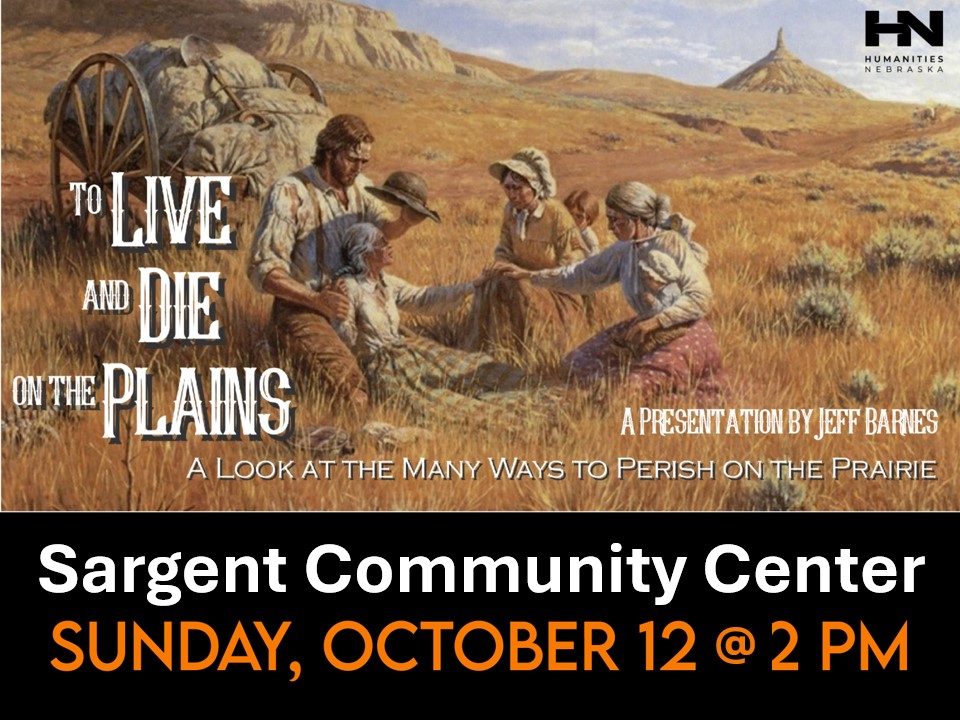
Although the greatest peacetime emigration in the history of the world took place across the Great Plains, an astounding number of the emigrants met their end suddenly, unexpectedly and sometimes violently there.
How those emigrants died is the topic of “To Live and Die on the Plains,” historian Jeff Barnes’s presentation on Sunday, October 12, at 2 p.m. at the Sargent Community Center. The 45-minute talk presents an astonishing tale of life and death on the Great Plains.
In fact, says Barnes, by driving on Nebraska’s Interstate 80 one could say they are driving
through the state’s largest and longest cemetery – the Platte River valley.
“There are thousands of unmarked graves throughout the valley, covered by roads, highways, fields, and quite possibly people’s homes,” said Barnes. “An estimated 20,000 people died on the Oregon Trail, about one in every 17. It was even worse for the Mormons, as one in ten died on their trail. Today, driving Interstate 80 in Nebraska, you’re passing on average more than 20 unmarked graves in every mile.”
Barnes is the first Humanities Nebraska speaker to present in all 93 Nebraska counties. He is the author of eight histories of Nebraska and the Great Plains, including The Great Plains Guide to Custer, The Great Plains Guide to Buffalo Bill, and Cut in Stone, Cast in Bronze: Nebraska’s Historical Markers and Monuments. A new edition of his first book, Forts of the Northern Plains, is now available from Bison Books.
A former newspaper reporter and editor, Barnes writes and lives in Omaha. He is a fifth-
generation Nebraskan, past trustee of the Nebraska State Historical Society, former chairman of the Nebraska Hall of Fame Commission, past marketing director of the Durham Museum and present trustee of the Nebraska State Historical Society Foundation.