This story is used with permission from the Callaway Courier. It originally appeared in their September 7th issue.
The Callaway Volunteer Fire Department recently appointed a new EMT Chief, and Mark Buss is on a mission to improve the emergency medical services of the community.
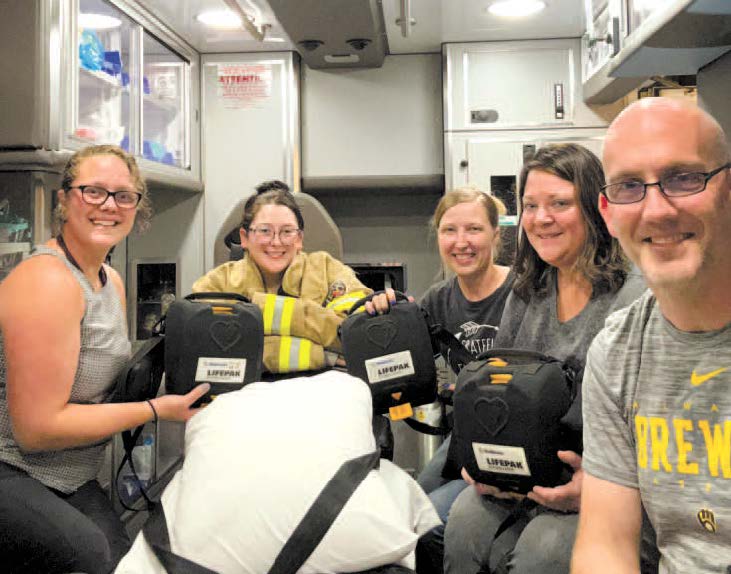
One way Buss is doing that is by inspecting and updating all of the AEDs throughout the village. “My main goal was to work on our community to make sure all of our AEDs are up to date and functioning appropriately,” Buss explained. “This includes checking that the pads inside are not expired and that the pads have been changed when needed.”
An Automated External Defibrillator (AED) is a portable medical device that analyzes a person’s heart rhythm during cardiac arrest, and, if necessary, delivers a shock to help the heart re-establish a correct heart rhythm. Buss said that all AEDs on the market today are intuitive, easy to use, and can save a life. “Honestly, another one of my goals was just to make the public aware of their locations throughout the community. We tried advertising this during EMS Week in May, so we are hoping this will help educate the public as well,” said Buss.
Buss is working with a biomedical engineering company called Bio-Electronics, out of Lincoln. “They will come to our community once a year to professionally check out our AEDs to ensure that they are functioning properly. The Callaway Rural Fire Board has graciously agreed to pick up the cost of that,” Buss shared.
There are a total of seven AEDs located throughout the village of Callaway. Those locations are: Callaway Public School, the Village Office, Callaway Community Center, Seven Valleys Senior Center, and St. Boniface Catholic Church. The Callaway Volunteer Fire Department has three devices in different response vehicles, and Callaway District Hospital also has the equipment but Buss said they maintain their own.
Buss said that some people may be intimidated at the thought of using an AED, or even knowing if one is necessary in the case of a medical emergency. However, he said we needn’t be afraid.
“These devices are super user-friendly. They turn on automatically and it starts prompting you on what to do next. It’s really for anyone, but we do offer some training as well to get people more comfortable not only on using an AED but on performing CPR,” Buss added. Buss emphasized the importance of activating the 911 system and having a professional walk the layperson through the steps and what to look for to determine whether an AED is the right course of action. However, users really don’t need to worry about using one inappropriately.
“The AED will only shock certain kinds of rhythms, like ventricular fibrillation or ventricular tachycardia,” Buss explained. “If the patient is not in those rhythms the machine will detect that and will not shock that patient.”
More than 350,000 people go into cardiac arrest each year outside of hospitals, according to the American Heart Association. The survival rate is only about 10 percent, but when an AED is used, those odds improve significantly. Dr. Myron Weisfeldt of Johns Hopkins University said it is estimated that about 1,700 lives are saved each year in the U.S. by bystanders using an AED.
“Early CPR and AED use is essential in the chain of survival for a patient in cardiac arrest. Those simple things to do can really make a difference in somebody’s outcome,” said Buss.
Buss moved to Callaway nearly three years ago and joined the rescue department right away. He works fulltime as a flight nurse/paramedic for the air ambulance service LifeNet, based in North Platte.
While going through the AED inspection project Buss said he was in contact with Callaway Public School, and they decided to take the project a step further. “We had a group of about five volunteer EMTs take a day and did two different sessions, to get people certified in Basic Life Support offered by the American Heart Association. Basic Life Support consists of CPR, AED use, rescue breathing, and reviving the choking patient in the adult, pediatric and infant population,” Buss said. “So we were able to get 35 of their staff certified who will be able to help in an emergency type situation.”
Callaway is not the only community benefiting from Buss’s passion. “Word spreads fast in these small communities and we have been able to work with some of the surrounding communities like Stapleton getting their AED updated and back in service at the Catholic Church,” he said proudly.
In one year alone, 436,000 Americans die from cardiac arrest. Globally, cardiac arrest claims more lives than colorectal cancer, breast cancer, prostate cancer, influenza, pneumonia, auto accidents, HIV, firearms, and
house fires combined. Knowing where an AED is located, and being trained in CPR has the potential to save thousands of lives.
For Buss, that education begins here.