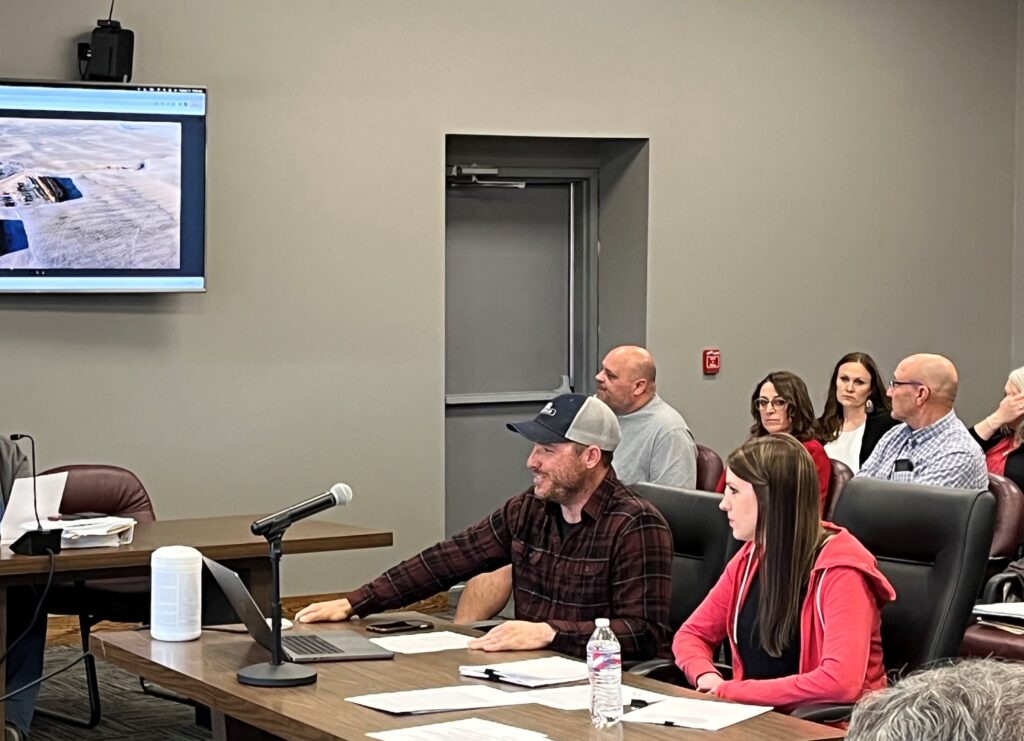
BROKEN BOW – At the Custer County Supervisors’ first April meeting, Evan and Sarah Bartak expressed concern to the 7 district representatives that the 10 years of work and love they’ve put into their 3-acre property outside of Merna is going to waste, literally.
“We currently have 3 massive manure piles, enough manure to spread over 3 pivots, less than a half mile directly south of our property,” Evan said.
The piles, according to the Bartaks, have been around for more than a year, and have totaled up to 7. One of the largest, shown in a slideshow presented to the supervisors, has been growing for 19 months; it dwarfs the pickup pictured in front of it, easily 4 times the truck’s length and at least 2 or 3 times as tall.
The manure has stockpiled as part of an organic farming effort by Merna Valley Farms; in order to be certified as an organic producer, a farm cannot use synthetic fertilizer, thus relying on more traditional methods of helping crops to grow.
Appearing before the supervisors marked the fourth appearance before a governing body for the couple: the pair has met once with the Nebraska Department of Environment and Energy, who told them that barring a 1000-foot proximity to a municipal well, regulations regarding such stockpiles were up to a county zoning board, with whom they’ve met twice in the past few months. The results from the work, Bartak said, have been less than encouraging.
“Unfortunately, there are no zoning regulations,” Bartak said, “No restrictions on placement, no time limits, any size limits or rules for large manure piles.”
The Bartaks’ reasons for lodging complaints are easy enough to puzzle out; the difficulty is in the solution, as zoning laws don’t quite draw the tangible flies and smells of manure. One of the Bartaks’ fears is that a continued lack of regulation could ultimately reduce rural residents in Custer County to something akin to peasantry, whose home value and living space are dictated by the whims and needs of farmers. Bartak, a large farmer himself, explained:
“Should any one person hold so much power over my property, its value, its quality? Because of the lack of rules regarding these piles, a farmer can do whatever they want, make the piles as big as they want, have them sit for as long as they want, just so long as they aren’t close to a municipal well.”
Hypothetically, the Bartaks posited, given the current well-proximity regulation and no others, a manure pile as large as the ones nearby could crop up as close as 100 feet from a home.
A solution proposed by the Bartaks would be both simple regulations and a possible permit process. Bartak reasoned that such a request for temporary manure piles wouldn’t be all that outlandish.
“As farmers, we’re required to get pesticide permits, chemigation permits, controlled burn permits. The list goes on. You need a permit to drive, to build, to own a gun. The permit would be insurance that the person spreading the manure is a responsible adult capable of understanding the rules.”
Those rules, under a permit, could look something like the following: the Bartaks have proposed that transported manure must be spread within 60 days of its transportation, and a permit would be required only if a pile is under three-quarters of a mile north or south of a school, church, public use area or under a half mile east or west of those landmarks.
The supervisors by necessity turned any potential decision regarding new regulations back to the zoning board for discussion and review during its coming meetings, with the promise that a subcommittee composed of three current supervisors to aid in the process.