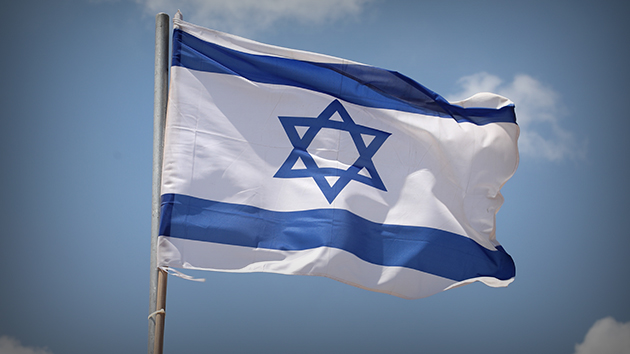
Votes from Israel’s parliamentary election were still being counted on Wednesday morning, after exit polls suggested a tight race between the two coalition blocs led by incumbent Prime Minister Benjamin Netanyahu and his prime challenger Gadi Eisenkot, the former chief of the Israel Defense Forces.
Polls closed at 10 p.m. local time on Tuesday after high turnout across the country.
The counting of votes was ongoing as of Wednesday, with the Israel Central Elections Committee saying that final results were not expected until Thursday.
Partial results released by the committee suggested that the coalitions of both Netanyahu and Eisenkot would fail to secure a majority of 61 seats in the Israeli parliament, the Knesset.
If the official results establish no clear winner, Israeli President Isaac Herzog will consult with party leaders and offer the chance to form a government to the leader he believes has the best chance of forming a government, usually the leader of the largest party. Netanyahu will remain caretaker prime minister while negotiations — which can last for several weeks — go on.
Netanyahu — who leads the right-wing Likud party — and Eisenkot — who leads the centrist Yashar party — both claimed a mandate from voters on Tuesday night.
“Two things have become clear. The first is unequivocal: the Likud is the largest party in Israel,” Netanyahu said in his post-election speech. “We must form a right-wing, national, strong government. That is what must be done. We must not, just not, endanger Israel and establish a government that is backed by anti-Zionist Arab parties.”
Security issues and the ongoing conflict with Iran — as well as questions over Netanyahu’s management of the war in Gaza — dominated the election campaign.
“Israel faces a singular historical opportunity, together with our partner President [Donald] Trump, to remove the existential threat of Iran once and for all,” Netanyahu said in his post-election speech.
Eisenkot, though, told supporters at his party election headquarters that the vote marked the end of the Netanyahu era. “We made history,” he said. “The public decided in favor of change. The coalition of failure has lost the trust of the people. The Israeli public voted against the continuation of Netanyahu’s tenure.”
“Netanyahu is a transitional prime minister, without a mandate or trust,” Eisenkot added. Addressing the prime minister directly, he continued, “Do not dare to use Israel’s security for your political needs.”
Party leaders will now hope to form a coalition capable of governing, but failure to do so may result in another election.
Between 2019 and 2022, Israeli voters went to the polls five times as parties tried and failed to form an adequate coalition in the Knesset. That period of deadlock ended with Netanyahu establishing what is widely considered to be the most right-wing government in Israeli history, with control of 64 of the Knesset’s 120 seats.
Voter turnout nationwide was at 77.7% as of Tuesday night, according to Israel’s Central Elections Committee — the highest figure since the election of 1999.
The high turnout was reflected across Israel’s demographic groups, with exit polls suggesting significant success for the country’s Arab-Israeli parties.
If that outcome is reflected in the official results, the two coalitions led by Netanyahu and Eisenkot may need the backing of the Arab-Israeli parties to secure a majority for their bloc in the Knesset.
Both Netanyahu and Eisenkot have previously ruled out forming a coalition with the Arab parties. In his post-election speech, Netanyahu suggested that any government that included Arab parties would “endanger Israel.”
ABC News’ Jordana Miller, Matt Rivers and Joe Simonetti contributed to this report.
Copyright © 2026, ABC Audio. All rights reserved.