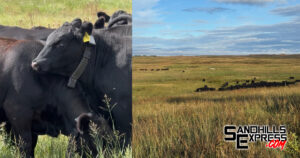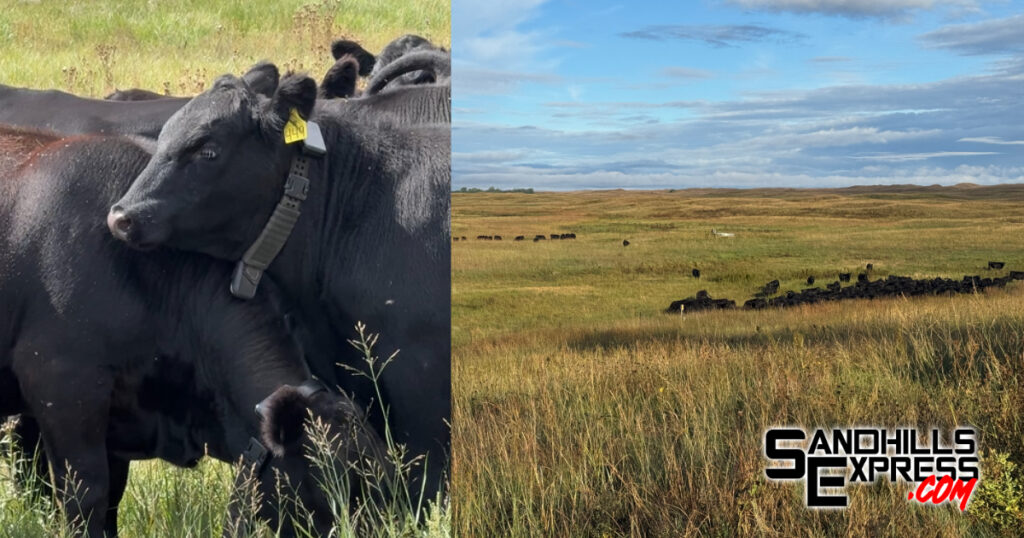
ANSELMO, Neb.— There’s no fence between cattle and more grass at the McGinn Ranch— at least not one you can see.
Instead, cattle grazing at the ranch outside Anselmo are wearing collars equipped with GPS, solar power, and a system designed to create boundaries without a strand of wire. The technology was the centerpiece of an adaptive grazing field day hosted by Noble Research Institute and Halter.
The discussion on Monday went well beyond the novelty of putting a virtual fence around a herd. The larger question was what an invisible fence might allow a rancher to do with the land.
View video content from the field day at the end of this story
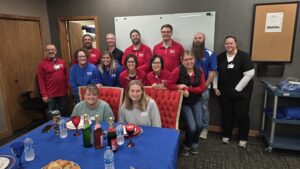
At the field day, ranchers came together to discuss rotational and adaptive grazing, soil health and livestock management before moving into the pasture to see Halter’s virtual fencing system in action. The connection made between the two topics was straightforward: adaptive grazing depends on a rancher’s ability to control where cattle graze, how intensely they graze, and perhaps most importantly, how long a pasture is allowed to rest before cattle return.
Those decisions can be difficult when using physical fencing. Building and moving poly wire takes time and labor, permanent fencing requires infrastructure, and a grazing plan can change quickly when weather or forage conditions change. The message conveyed at the event was although virtual fencing doesn’t eliminate management decisions, it can make it easier for a rancher to act on them.
That’s where the collars, the cattle, and the soil health discussion come together.
Noble Research Institute Education Partnerships and Outreach Specialist Caitlin Word told the group that the names attached to grazing systems (rotational, adaptive, intensive, cell, etc.) matter less than the underlying principles. At their core, the systems are about managing grazing pressure and giving plants time to recover.
Word said virtual fencing can allow a rancher to make changes triggered by significant rain, a dry stretch, or forage availability much more quickly than with physical fence. But she also stressed that the technology isn’t a substitute for understanding grazing management.
“A tool is only as effective as the person holding it,” Word said.
Noble works with ranchers on the ecological, livestock, and business components of a grazing operation, with Word describing any ranch as a three-legged pot supported by land, livestock, and finances. The people running the ranch are in the pot, supported by all three.
Word said she had been skeptical of virtual fencing technology when she first encountered an earlier system, believing it could create a barrier between ranchers and their livestock rather than strengthen good stockmanship. Her experience with Halter has changed that opinion, and she now sees the technology as something that can be incorporated into good livestock management rather than replacing it.
That distinction matters because the collars require the rancher to understand cattle behavior and the condition of the land. The only difference is that they change how some of the work gets done.
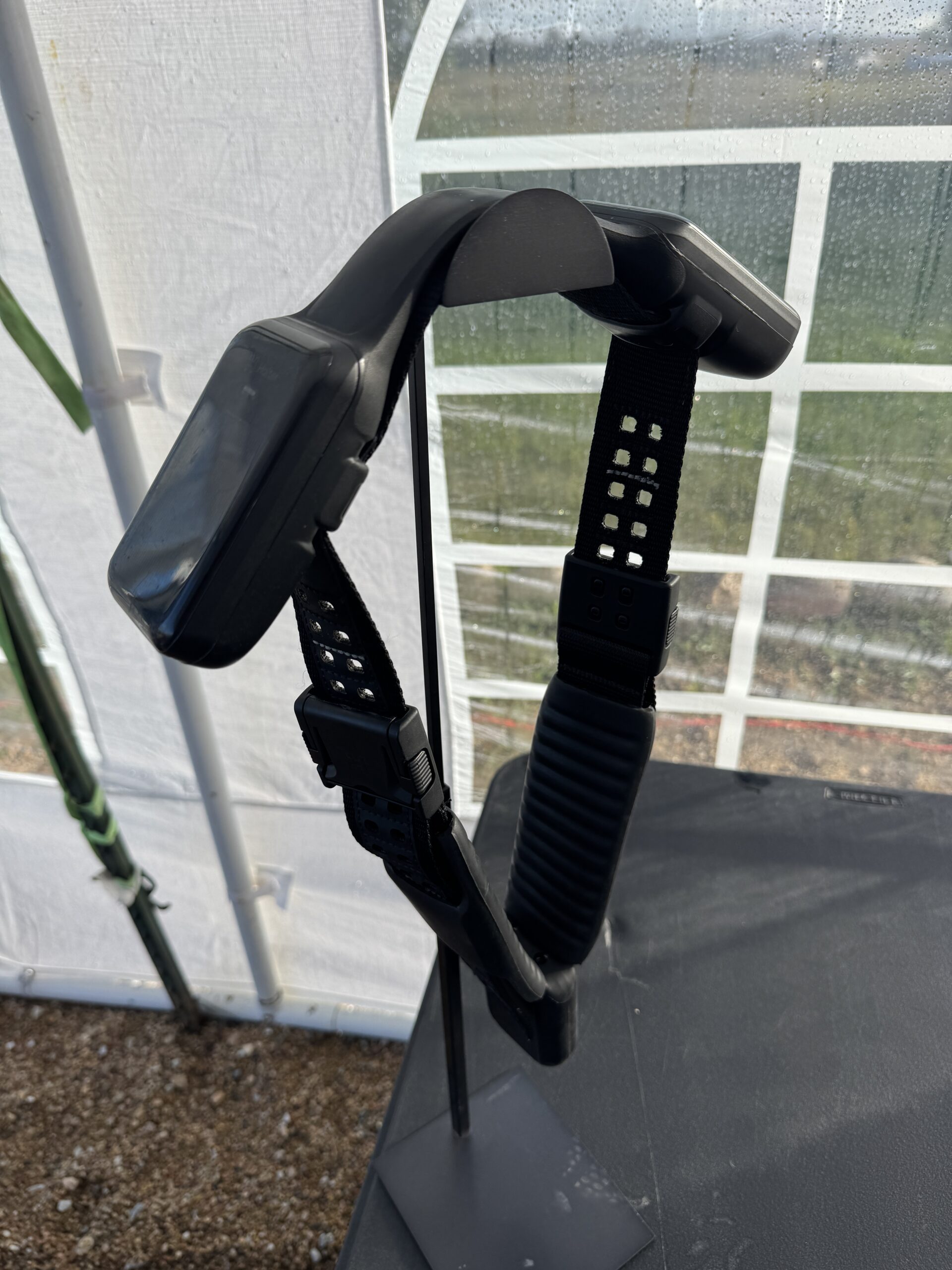
Anna Kate Link, Territory Manager for Halter, explained to the group how the system works. Each collar uses GPS and a satellite connection to communicate with the rancher’s app, allowing the rancher to create virtual boundaries and track individual animals. The collars are solar powered, and the system is designed to work in remote areas without relying on a traditional network of fence lines or communication towers.
The cattle receive different cues depending on what the rancher is asking them to do. As an animal approaches a virtual boundary, the collar provides directional audio cues, with the animal receiving a cue from the appropriate side of the collar. If it continues across the boundary, the system can deliver a low electrical pulse after the animal travels a predetermined distance.
A separate movement cue can also be used. When a rancher changes the virtual fence and wants cattle to move to a new area, the collars can provide a vibration cue directing the animals to the new grazing area.
Matt McGinn said the training process at his ranch only took a couple of days.
Now a few months in, the change to his day-to-day grazing routine has been significant. McGinn said there was a time that roughly two miles of poly wire could be put out in a day, while his cattle could be moved between grazing areas about every couple weeks. With the virtual fencing system, he can make moves in days and change the grazing boundary with his phone.
A much more fluid grazing system is the result. Instead of waiting for a scheduled move or finding time to construct another area, McGinn can make a change when he thinks the pasture or the cattle need it. He can also see where his cattle are at any time, which also eases some challenges of managing a herd across a ranch.
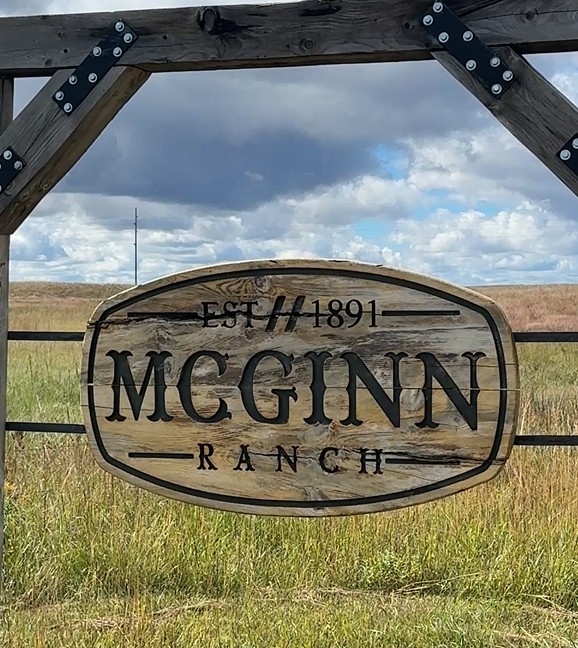
McGinn said he believes the cattle have actually become calmer since the collars were introduced. He said they seemed to learn the system quickly, and he has noticed what he described as a more content demeanor among the herd.
The technology is new to McGinn’s operation, but the motivation behind changing how cattle grazed goes back further.
The McGinn Ranch was founded in 1891, and McGinn said his family’s management practices changed over time as economic conditions and drought put pressure on the operation. During the 2002 drought, the ranch sold roughly 500 cows and laid off three employees. Later, as input costs rose faster than cattle prices, McGinn said the operation found itself putting more pressure on its land in an effort to sustain the cow herd.
Those experiences helped push him toward a different approach to managing the ranch, with more attention paid to the long term condition of the land rather than simply trying to get as much production from it as possible in a given year. The focus moved from asking how many cattle he could run and how often he can move them to looking at the plants themselves. McGinn used a plant identification app to learn what’s growing on the ranch while watching how cattle interact with different plants during different parts of the year.
That kind of observation is what Word encouraged ranchers to do during the field portion of the event. Rather than looking only at the cattle, she asked attendees to look down and consider ground cover, biodiversity, live roots, residual plant material, and even the condition and “bounce” of the soil.
McGinn said that in the hustle and bustle on a ranch, it’s easy to spend more time in a side-by-side UTV cruising by cattle and fields at a speed that doesn’t allow seeing what is actually happening. He said he walks a good distance at a time often to really get a good look at things up close.
Word cautioned against the idea that ranchers have to completely transform their operation overnight or adopt an extreme grazing system to make progress. Even a single section of fence inside a larger pasture can offer a little flexibility.
“Don’t let perfection get in the way of good,” was one message she shared.
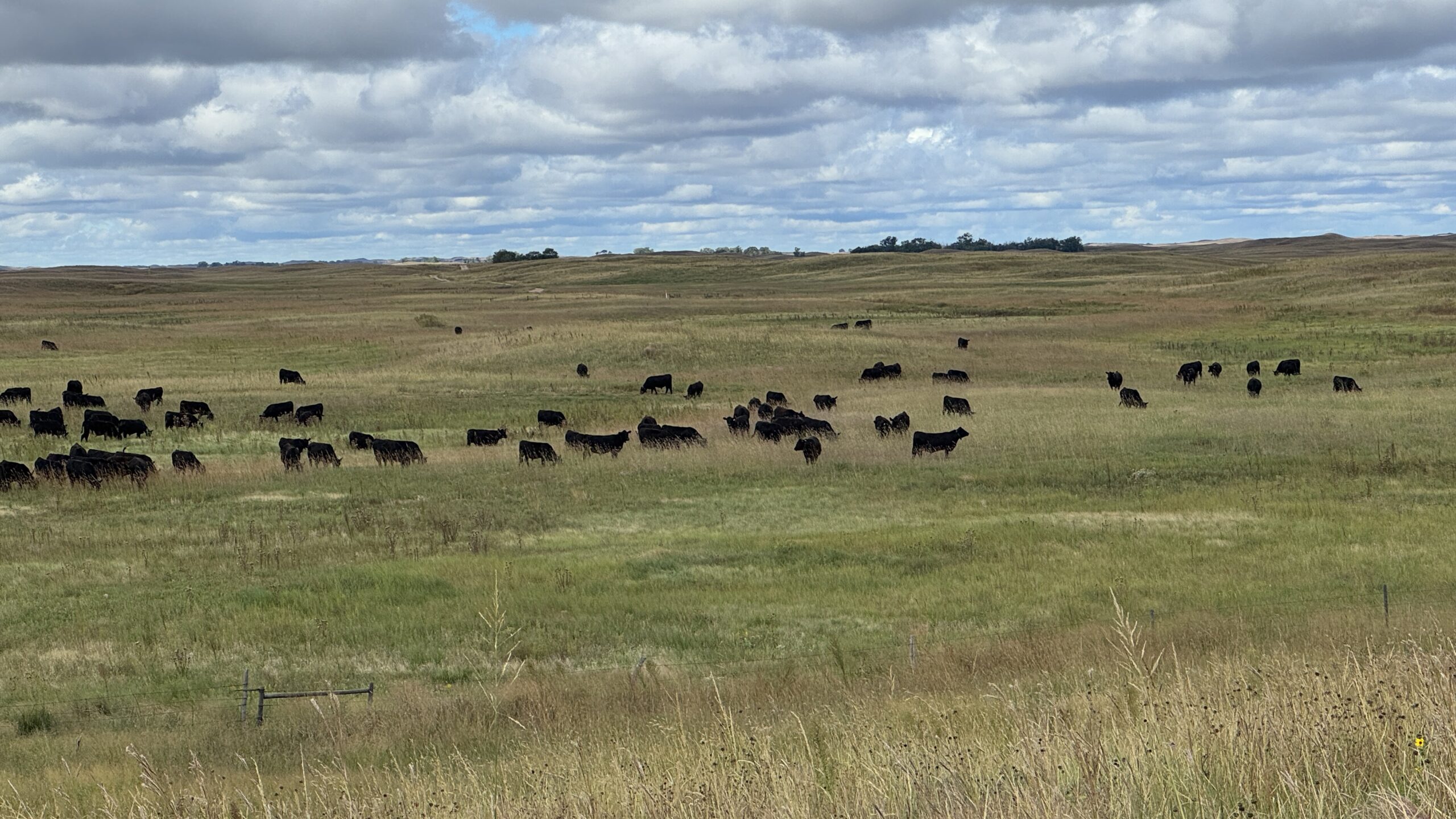
That idea of flexibility is what Halter’s system takes and makes easier by removing physical limitations. Link said Nebraska is approaching 25,000 cattle wearing Halter collars, with Nebraska operations using the technology from herds of around 100 head to much larger operations. Halter, which began in New Zealand with a collar made of Tupperware and someone’s belt, went international as the technology progressed.
Today, safeguards are built into the system including a breakaway feature that allows the collars to come off if an animal becomes snagged. If connection to satellites is lost, collars can hold the cattle in place so a rancher can physically approach the herd and use Bluetooth to manually manage the cattle.
Water, and cattle having access to it with each virtual fence, was another of many examples of what ranchers need to make a call on themselves reinforcing Word’s message of the technology being a tool. The collars can make the boundary, locate cattle, change grazing patterns, and move cattle without building a physical fence, but it can’t replace the need to understand the cattle or the land.
The lesson everyone learned through the day wasn’t that ranchers can fence without wire now. It was that removing a physical limitation of grazing management can give them the freedom to respond in different ways. The technology creates the boundary, but ranchers still need to decide where those boundaries should be and when they should move based on what the land is telling them.