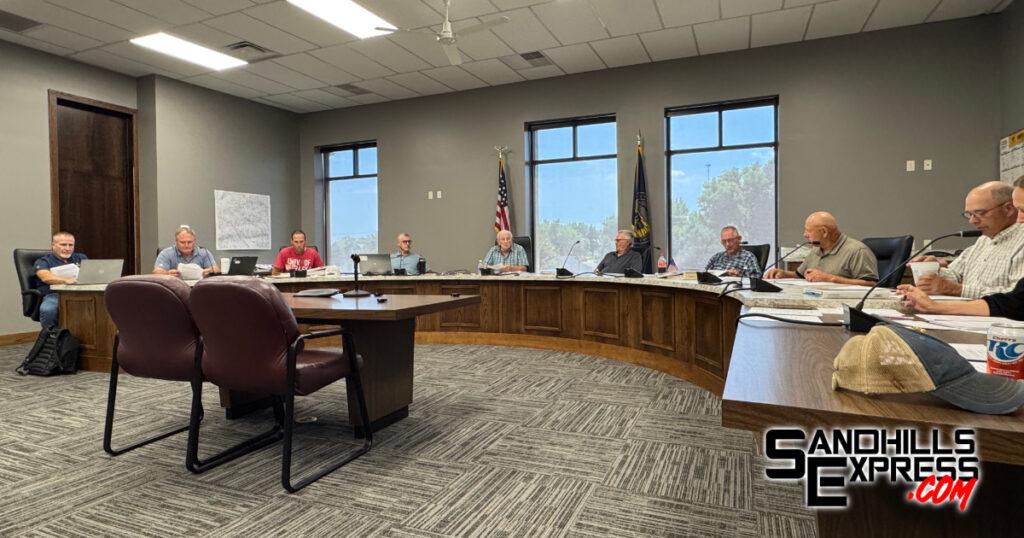
BROKEN BOW, Neb.— The Custer County Planning Commission continued its work on proposed regulations for data centers Wednesday, making several changes to a working draft before unanimously voting to advance the proposal to a public hearing next month.
All commission members were present for the meeting.
The regulations are being developed during a six month moratorium on data center and related tech facilities that runs through the end of September. Following their July meeting when a committee was formed, the work began on researching and developing the proposals included in the working draft handed out to those in attendance on Wednesday.
Commission Chairman Butch McGinn emphasized that the document remains a rough draft and is not yet a final proposal. It was also made clear that changes can still be made during and following the public hearing before a final recommendation is given to the Custer County Board of Supervisors.
The regulations reviewed during the meeting on Wednesday cover facility considerations like size and location, water use, cooling systems, noise, electrical demand, emergency response, security, and abandonment or decommissioning (should it happen).
View the full document made available at the meeting here: Planning Commission Data Center Draft 8/19/26
Cooling and water use
Two versions of language addressing cooling system and water consumption were considered on Wednesday.
Ultimately, language that states that all facilities would be required to use either direct-to-chip liquid cooling or a closed loop liquid cooling system was chosen. Cooling systems using municipal water or groundwater that consume more than 50 gallons per minute under normal operating conditions would be prohibited.
The 50 gallon figure was discussed as being tied to additional requirements for wells that are capable of a higher gallon per minute ability.
Air cooled systems are also prohibited in the draft, with noise being named as one of the reasons. Continuous wastewater discharge from normal operations is also prohibited in the language.
Larger facility, greater setback distance
The document from Wednesday’s meeting puts facilities into three categories based on their electrical demand:
- Small facilities: 1 to 10 megawatts
- Medium facilities: 10 to 20 megawatts
- Large facilities: 20 megawatts or more
The larger the facility, the further the setback from ‘non-participating residential dwellings and public uses’. Small facilities would have a proposed setback of a quarter mile, medium would be setback a half mile, and large facilities would have a three mile setback.
Two clarifications were made: First, that setback distances would be measured from the facility itself rather than the property boundary. Second, that if multiple facilities are located near the same electrical source the setbacks would apply to each individual facility.
Emergency response considerations
Vegetation around data center buildings and infrastructure were addressed on Wednesday as well. The working draft distance of 100 feet for tree and shrub distance was changed to 300 feet following input from Custer County Emergency Manager Mark Rempe.
Rempe said the extra distance would give emergency responders more room to operate and be safe if a fire were to happen.
Also regarding emergency response, the commission approved adding language requiring a data center operator to provide, at no cost to local emergency response agencies, necessary fire suppression, hazardous materials response, and safety equipment as the agencies determine. It would need to be provided before the facility starts operating, and be available throughout its operation.
As far as backup energy systems, battery energy storage was prohibited. Non-battery systems like diesel or natural gas generators were approved to be used as long as they abide by noise, air quality, safety, and operational requirements the same as the facilities themselves.
The commission discussed whether backup generators could be used during electrical load control situations like during irrigation season. It was determined that was okay, as long as they operate within the established requirements of the facilities for the entire time running on generators.
Avoiding ‘workaround’ when it comes to abandonment
The current draft states that a facility would be considered abandoned if data processing activity ceases for a continuous 12 month period. A situation was considered: a company restarting operations briefly before the 12 month period expires simply to avoid being considered abandoned.
That issue will be looked at further before the public hearing, specifically exploring if a more meaningful measure of continued operation should be required.
Financial assurance tied to decommissioning was also discussed. The draft presented Wednesday speaks toward an irrevocable letter of credit, but it was questioned whether that would provide sufficient protection. It’s possible that verbiage is removed in favor of just escrow accounts or surety bonds before the public hearing.
Conditional use permits are attached to the property
Toward the end of Wednesday’s meeting, a question was raised about whether a new company purchasing a property with an existing data center conditional use permit would have to obtain another permit.
Zoning Administrator Darci Tibbs clarified that a permit runs with the property rather than its developer, so buyers would not need to get a new permit as long as the facility use stays consistent with what was approved originally.
Public hearing set for September 23
Following the discussion and proposed changes, a unanimous approval was given to revised working draft to be prepared for a public hearing on September 23 at 1:45 PM. The meeting itself would begin at 1:30 PM in the Supervisor’s room at the courthouse.
Once the Planning Commission’s work is completed and they are satisfied with a draft taking into account all research, amendments, and public comment the regulations would move to the Custer County Board of Supervisors for consideration.
Other items from Wednesday’s meeting
- A moratorium was put in place for 12 months regarding battery energy storage
- The comprehensive plan was identified as being old and outdated enough that it will need addressed
- The Prairie Hills Wind project south of Mason City now has mud mat installed, site studies are continuing, and a foundation or well drilling for the operation and management building could happen soon
Again, the next meeting of the Custer County Planning Commission starts at 1:30 PM on September 23. The public hearing regarding data center regulations is set for 1:45 PM.