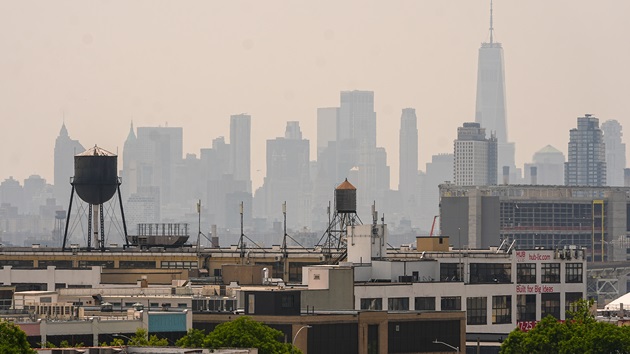
(NEW YORK) — Nearly half of Americans — 152.3 million people — now live in places with unhealthy levels of ozone or particle pollution (PM2.5), two of the most dangerous air pollutants.
The American Lung Association’s 2026 “State of the Air” report finds that more than 129 million people live in counties with failing grades for ozone pollution. This type of pollution forms when sunlight interacts with compounds emitted from cars, industry and chemicals, creating harmful ground-level ozone in the air.
About 62 million people live in counties with failing grades for daily particle pollution spikes, which consist of tiny particles in the air produced by sources like car exhaust, power plants, construction, fires and dust, according to the report.
Exposure to dirty air was not equal, the report found.
People of color were more than twice as likely to live in areas failing all major pollution measures, according to the report.
“[In] areas where people have fewer socioeconomic resources … there’s a snowball effect because many of these areas may have less access to healthy food, less safe places to work out outside and less access to health care,” Dr. Afif El-Hasan, a board-certified pulmonologist and an American Lung Association spokesperson, told ABC News.
Many of these areas with high pollution are also underserved areas or have lower socioeconomic means, El-Hasan said.
Breathing in contaminated air not only makes people sicker; it affects family dynamics, finances and just about every other aspect of life, the report’s authors say.
Children are disproportionately affected as well. About 33.5 million of them are living in counties that received failing grades for at least one major air pollutant.
“Children who grow up in areas with polluted air are going to have decreased lung development compared to children who grow up having been exposed to clean air,” El-Hasan said. “Ultimately that leads to adults who have lower lung capacity than they would otherwise have — and that’s not reversible.”
And because the pollution compromises the body’s defenses, infections like the cold, flu and even COVID may be more severe in people who live in high-pollution areas, the findings suggested.
Despite decades of progress under the Clean Air Act, which was signed into law in 1970, the report found that air pollution is intensifying in many parts of the country.
Ozone pollution has worsened and now affects more people than in the past.
Climate change helps drive this trend by fueling extreme heat, drought and wildfires, the study suggested. And, while particle pollution has shown slight improvements, it still exposes far more people than historic low levels seen in the mid-2010s.
If you live in a place with poor air quality, there are steps you can take to protect your health, according to the American Lung Association.
Limit time outdoors on poor air quality days and check daily conditions. Use a high-quality mask like an N95 respirator and keep indoor air clean with filtration when pollution levels are high. Exercise indoors on bad air quality days.
Studies have also shown that staying up to date on vaccines, including flu and COVID shots, can also offer some protection.
Additionally, it’s critical the U.S. maintains the gains it has made on air quality over decades of stronger public health policies, El-Hasan said.
“Air does not respect borders — it will go everywhere,” El-Hasan said. “People should understand that what they do in terms of making sure policies are protecting air locally — it doesn’t just help you. If we are all helping keep our local air clean, it will help the rest of the nation as well.”
Grace Hagan M.D., is an internal medicine resident at Mayo Clinic and a member of the ABC News Medical Unit.
Copyright © 2026, ABC Audio. All rights reserved.