
▶ Watch Video: Latest on Iran as Trump insists war will end soon
Washington — The Senate on Wednesday defeated another war powers resolution aimed at curbing President Trump’s ability to use further military force against Iran, with Democrats vowing to keep trying to rein in the president.
A motion to discharge the measure from committee failed in a 47 to 52 vote, with Republican Sen. Rand Paul of Kentucky and Democratic Sen. John Fetterman of Pennsylvania crossing the aisle.
It was the fourth time Democrats in the Senate had forced a vote on the issue since the war began on Feb. 28.
The resolution, led by Democratic Sen. Tammy Duckworth of Illinois, would have directed President Trump “to remove the United States Armed Forces from hostilities within or against Iran, unless explicitly authorized by a declaration of war or a specific authorization for use of military force.”
Speaking at a news conference Tuesday, Duckworth said “we cannot let this chaos continue unchecked.”
“As our troops continue to sacrifice whatever is asked of them, we senators need to do the absolute minimum required of us,” Duckworth, a former Blackhawk helicopter pilot, said.
The Illinois Democrat said the Senate must vote to “end Trump’s illegal war of choice.”
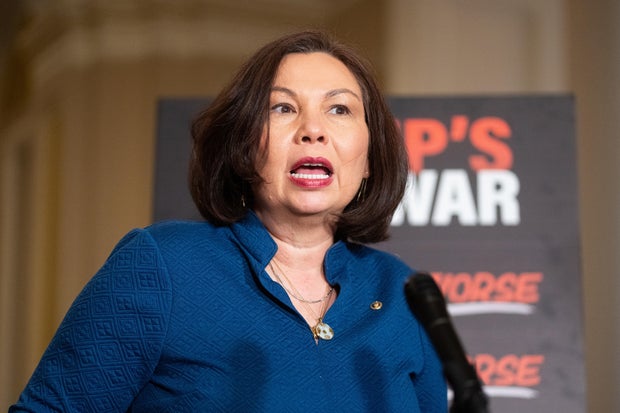
“My Republican colleagues have a choice also,” Duckworth said. “It’s simple: they can vote with me to end this conflict and prove that they’re actually putting America first, or they can vote to put Trump’s ego first. With this war growing more and more out of control each day, it is clear that they cannot continue to do both.”
The vote marked the first time the Senate has weighed in on the war since the president ramped up his rhetoric ahead of a deadline for Iran to reopen the Strait of Hormuz, including with his threat last week that a “whole civilization will die.” The threat prompted widespread criticism from Democrats and a small number of Republicans, like Sen. Lisa Murkowski of Alaska, who said it “cannot be excused away as an attempt to gain leverage in negotiations with Iran.” Within hours, the president announced that a two-week ceasefire had been reached with the Islamic Republic.
Senate Minority Leader Chuck Schumer urged Republicans to break with their party and support advancing the resolution ahead of the vote on Wednesday.
“Republicans have voted against this resolution three times now. But as the war drags on for 47 days with no end in sight, they should join us on this resolution and end the war once and for all,” Schumer said on the Senate floor. “If the Republicans vote no again, we will continue to force votes on these resolutions every week until either this war ends or the Republicans get the courage to stand up to Donald Trump.”
Republicans eye 60-day mark to reconsider support
A growing number of Republicans have indicated that they could reverse their support for the war if it doesn’t end before the 60-day mark — the cap on any unauthorized engagements under the 1973 War Powers Resolution.
Congress passed the War Powers Resolution in response to the Vietnam War as a check on the president’s power to enter armed conflict without consent from the legislative branch. It requires the president to consult with Congress in “every possible instance” ahead of the introduction of any military forces.
The president must report to Congress within 48 hours of deploying forces if Congress hasn’t authorized a declaration of war, and it caps any unauthorized engagement at 60 days. That deadline can be extended to 90 days if the president certifies to Congress in writing that “unavoidable military necessity” related to the safety of U.S. armed forces requires it.
GOP Sen. John Curtis of Utah wrote in an op-ed earlier this month that while he supports “the president’s actions taken in defense of American lives and interests,” he would not support “ongoing military action beyond a 60-day window without congressional approval.”
Sen. Mike Rounds, a South Dakota Republican, pointed to the same timeline on Tuesday, telling reporters that “we do expect that the administration will be laying out their plan for after the end of seven, eight, nine weeks.”
“We have to know what the next steps are, and that’s a part of our due diligence,” Rounds said.
Asked about Congress authorizing the war as it approaches the 60- or 90-day mark, Senate Majority Leader John Thune said at this point, most of the GOP conference feels “pretty good” about what the U.S. has been able to achieve in Iran.
“I think the administration has a clear objective, a clear plan, and if they can execute on it, hopefully, that question won’t be a necessary one that we’ll have to answer,” he added.