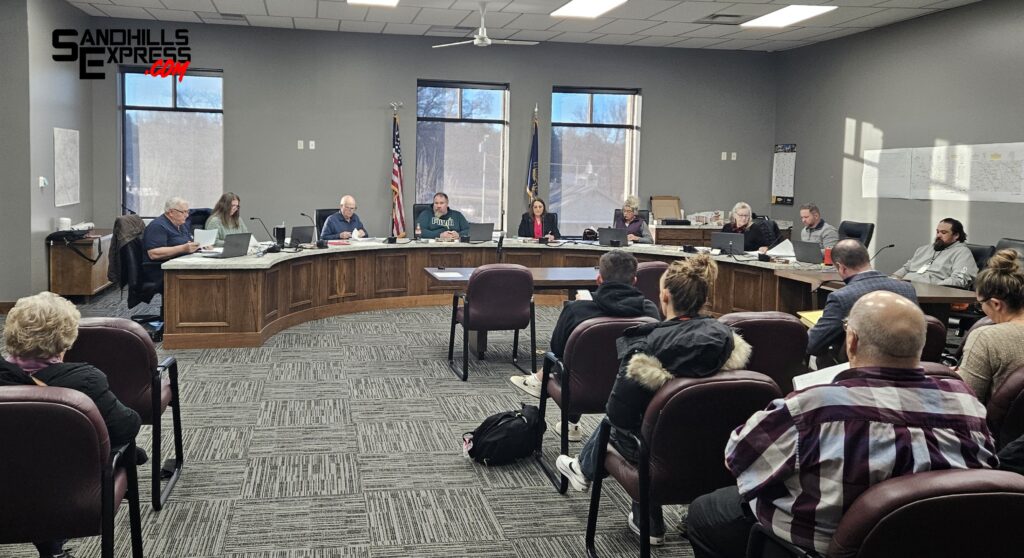
The Custer County Supervisors met in regular session Tuesday morning at 9:00 AM, December 30 at the Custer County Courthouse in Broken Bow. All members of the Supervisors were present, including new District 3 Supervisor Clay Govier.
Lengthy Discussion of Recycling Center Results in a New Date for Decisions
Audience seating was nearly full, with many members of the public interested in the fate of the Custer County Recycling Center. After concluding most of the early morning’s business (see below), Recycling Center Manager Kelly Flynn took his seat at the center table to begin the discussion.
Flynn had been collecting information regarding grant funding avenues – with more information still to be collected even at the time of the meeting.
Flynn told the Supervisors that working with agencies such as Custer County Economic Development Corporation, the Broken Bow Chamber of Commerce, and the Custer County Foundation, he had identified two primary grant sources for recycling – the Nebraska Recycling Council and the Nebraska State Department of Water, Energy, and Environment (DWEE). The Recycling Center has received grants from both organizations in the past, primarily for the purchase or replacement of equipment used in the Center. However, grants to cover operating costs, such as payroll and transportation are also available, noting that the Upper Loup Natural Resources District in Thedford and Keep Loup Basin Beautiful in Burwell use these grants for operating costs.
According to Flynn, grant writing for grants from both organizations generally begins in July, with submission deadlines in late summer/early fall, and recipients announced in December. New funding from either source would not be available until January 2027.
Flynn then answered a number of questions from the supervisors. District 1 Supervisor Anne Gibbons noted that operational costs are probably the largest driver of the Center budget. When asked by Gibbons about out-of-county users bringing cardboard to the recycling center, Flynn stated that such customers are charged $.02 per pound. The fee has been in place since 2018 – Gibbons suggested that was a fee that could likely be raised to help recover Center costs.
Govier asked Flynn whether bringing in materials from outside of the county was value-added, or creating more work than could be supported by the Center’s current funding. Flynn stated the larger volume of recyclables that could be received and processed by the center, the better.
Govier then noted that revenue and volume has decreased over the last 10 years. Flynn responded that the elimination of glass recycling impacted the overall volume, along with the decrease in the actual number and size of printed newspapers affecting the volume of paper recycled. Other business changes, such as the end of an agreement with BD for cardboard recycling have also impacted the flow of materials through the Center.
Gibbons suggested that commercial users with high volumes of cardboard recycling should foot the majority of the bill, as opposed to individual tax payers, asking “why should I pay for their recycling?” Flynn noted that with a 2025 population of 10,485 people in Custer County, the total bill for each person is $16.69, per person, per year.
Gibbons later stated that she felt there were better uses for the money spent on the recycling center, and would have preferred to use the over $580,000 that the Center has lost over the last five years on something positive for the county.
Flynn disputed the notion that the funding was a loss, responding that in that time the Center had recycled over 3,000 tons of material that would have otherwise ended up in a landfill. The materials recycled saved funding on landfill fees and were re-used to create new products.
“Recycling is designed to reduce solid waste – and its doing that,” said Flynn. “It’s been successful every year … thirty years its been doing that.”
Flynn pointed to the 10,000 lbs of materials recycled by the Broken Bow Public Schools from packing materials for items brought in for new classrooms since August as another example of cardboard kept out of landfills.
As the discussion turned to charging fees to different communities for use of the Custer County Recycling Center, it was noted that at least some had expressed a concern that the budget for their agency was set – adding new expenses was not going to be feasible at this point.
District 4 Supervisor James Markham suggested that it was going to be necessary to both have a plan for how much the county might charge outside users, and also to know what communities would be willing to contribute.
Supervisors Chairperson Chip Blowers noted that one prior suggestion had been to place the fate of the Recycling Center on a future ballot. Blowers and Custer County Attorney Steven Bowers reviewed the requirements to do so and determined this would not be feasible.
Bowers stated ballot measures must pertain to either statute or constitutional questions – this issue meets neither definition. Even attempting to phrase the question as a statutory issue would likely result in language too complicated to pass processes required to ensure ballot measures are simple yes/no questions.
Govier reiterated that the county is still in a lease agreement with Myers Construction for use of the building housing the Recycling Center until February 2028 – another issue to consider regarding the fate of the program. However, the Supervisors voted in favor expressing to Myers Construction that the lease agreement would not be automatically renewed at the end of that period – a measure set to help extricate the County from the lease when the time came if needed.
Public comments to the Supervisors were almost entirely in favor of the Recycling Center.
Donnis Hueftle-Bullock noted that recycling is not difficult, but that it is important as a duty to future generations to minimize what is being put into the land.
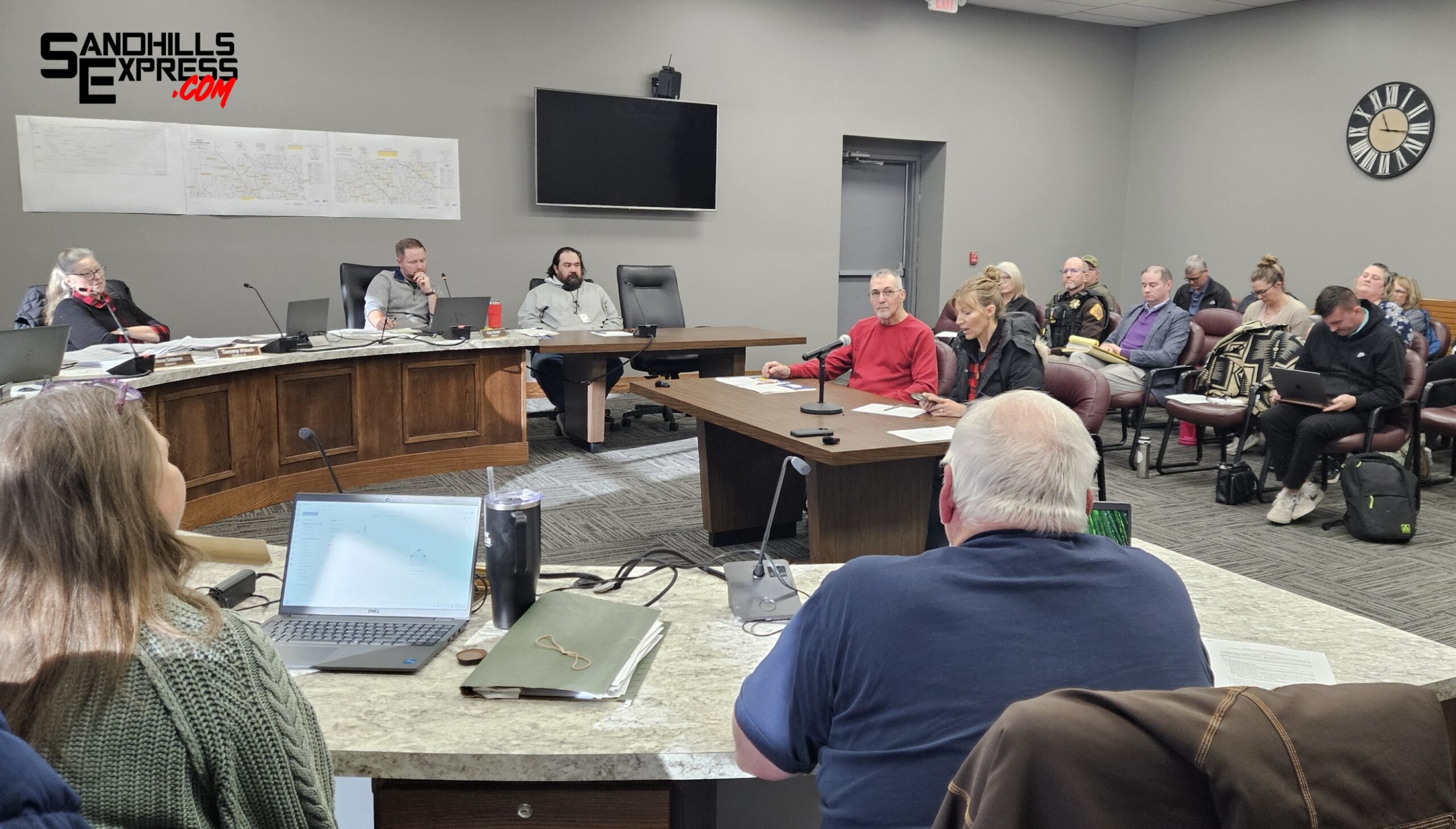
Denise Sughayar agreed, stating, “Cost is not just in dollars. We’re only beginning to scratch the surface as far as the impacts of microplastics on our environment and health. And we’re going to see that continue to increase as all these things we’re putting into the landfill start to decompose.”
Cliff Burnett reiterated a common theme among speakers, stating, “You’re looking at this wrong. It’s a public service, and it’s not made to make money.”
Several speakers noted that there are County services, including specific roads and bridges, schools, and law enforcement that they may not currently use, but are funded by all tax payers for the common good – including recycling among those goods.
Mark Cardoza noted though that this may not be a question of killing recycling as much as simply fiscal responsibility, stating, “There is a finite amount of money that comes into this county and of course this board is not in the business to make money but I think they should be in the business of saving money wherever they can because there’s a lot of stuff that needs to be paid for. The only way you’re going to get more money to have all these other things that are going to come up in the future is raising taxes.”
In the end, two motions regarding the ongoing status of the recycling center were made. A motion by District 2 Supervisor Tammy Kleeb to continue funding the center through February of 2028 when the building lease expires was defeated by Supervisors Gibbons, Markham, Longmore, and Blowers.
A motion to continue funding the Center and table the discussion until June 1, 2026 while gathering additional information about grants and support from area communities passed unanimously.
Supervisors Hear from Benefit Management, Salary Committee
Just prior to the recycling discussion, Dan Duren of insurance group Benefit Management provided an update on the County’s new policy plans. The company had reviewed Health Savings Account (HSA) plans of various local banks and recommended the County establish their HSA plans through Nebraska State Bank – a suggestion adopted by the Supervisors. Duren noted the lack of fees for HSAs, an existing relationship between the County and Bank, and organizational stability as factors in the recommendation.
Regarding healthcare reimbursement, the County’s planned expenses were adjusted some as a result of the discussion with Druen. The County Clerk’s office had already established an account with Point C, the servicing agent recommended by Benefit Management. The amount carried in the account used to pay costs to medical providers was changed from $75,000 to $50,000 deposited twice per year.
Duren stated 25 County employees total had enrolled in the High-Deductible HSA plan with another 49 remaining on the traditional plan. New insurance ID cards have been mailed, though Duren wouldn’t comment on when they would arrive through the mail.
Following the Recycling discussion, the committee appointed to address pay for County officials presented their recommendations for pay rates for 2027 – 2030. The committee reviewed factors for counties similar to Custer County, including Colfax, Cumming, Hamilton, Red Willow and Wayne counties. They found that Custer County was 2nd highest in the group in population and property valuation, and middle-of-the-pack (4th) in terms of salaries paid to officials.
Based on the Salary Committee’s recommendation, the Supervisors approved pay raises of 4.5%, in 2027 and then 3% for 2028, 2029 and 2030. For Elected officials, this results in 2027 salaries of:
$28,892.88 for the Supervisors
$74,661.81 for the County Clerk, Treasurer, Clerk of the Court, and Register of Deeds
$92,717 for the Custer County Sheriff
$110,018 for the County Attorney.
Pay scales for deputies to the elected officials are set at 65% – 75% of their supervisor’s rate. Pay Scales for Sheriffs Deputies are between 75% – 85% of the Sheriff’s pay.
Other Supervisors Activities
- Approval of Minutes from the December 9 meeting were deferred to the next meeting, as Supervisors Chairperson Blowers had requested additional information be added regarding community input to the Computer Aided Dispatching discussion.
- Most of the Supervisors had attended the December 17 – 19 State Conference in Kearney. More on this in a separate story.
- In Board of Equalization activities, the Supervisors approved an error in tax levies caused by a shift in information for SEM and Cozad School Districts. The error would have resulted in tax payers in those areas being over-taxed.
- The Supervisors approved the County Local Emergency Operations Plan (LEOP). Emergency Manager Mark Rempe indicated the plan includes sub-parts for emergency response from all 11 communities in Custer County. After approval by the Supervisors, the LEOP will be sent to the Nebraska Emergency Management Agency for review and further approval.
- County Veterans Service Officer Emory Haynes presented an MOU for approval allowing access to the State VA’s VETRASPEC electronic system. The VETRASPEC system allows county service officers to coordinate and manage support for veterans in their area.
- Troy Waltz of the Custer County Extension office requested renewal of Board Member Bonnie Weinman for a second three-year term.
The meeting of the Custer County Supervisors adjourned at 11:55 AM. The next meeting of the Custer County Supervisors will be January 13 at 9:00 AM in the Supervisors Conference Room on the top floor of the Custer County Courthouse.