The Nebraska Sandhills Grazing Conference was held on Thursday, June 13th, at the One Box Convention Center. No-till on the Plains, a non-profit educational organization, hosted the conference with a mission to provide education and networking on agricultural production systems that model nature. This year, the focus was on regrowing Sandhills Plants through non-traditional methods. The conference featured insightful presentations from guest Speakers, including Jeff Nichols, Logan Pribbeno, Kevin Sedivec, and Matt McGinn.
Jeff Nichols’ presentation was titled “NRCS Practices on Grazing Lands.” Nichols is a State Range Management Specialist associated with EQIP, which stands for Environmental Quality Incentive Program, GPGI or Great Plains Grasslands Initiative, and CPS, the Conservation Security Program. Jeff had many things to say about reducing Woody Encroachment on Grasslands by using primary practices such as Prescribed Burning, Prescribed Grazing, Mechanical Brush Management, and Pest Management using the PAMS approach, which stands for Prevent, Avoidance, Monitor, and Suppress.
Logan Pribbeno, is a 5th Generation Rancher on the Wine Glass Ranch, a ranch with 5,000 acres of dryland farm ground and 2,000 stockers and cattle, with a team of 6 and a half full-time employees, in Imperial Nebraska. His presentation was titled “Grazing is the Answer.” Logan discussed growth opportunities, the stocker forage chain, and how cover crops are a great alternative to herbicides since herbicides are becoming less effective. He also suggested partnering with surrounding farmers and ranchers to integrate cattle with each other’s lands.
Matt McGinn, is a 5th Generation Rancher from the McGinn Ranch north of Anselmo. Matt and his family run a commercial cow-calf, custom grazing operation. The McGinn ranch specializes in regenerative ranching practices and utilizes adaptive grazing principles to improve the land and calf performance. Matt’s presentation was titled “Wildfire and Rangeland Recovery”. McGinn talked about the Rancher/Farmer Trap, which is overgrazing and overhaying.
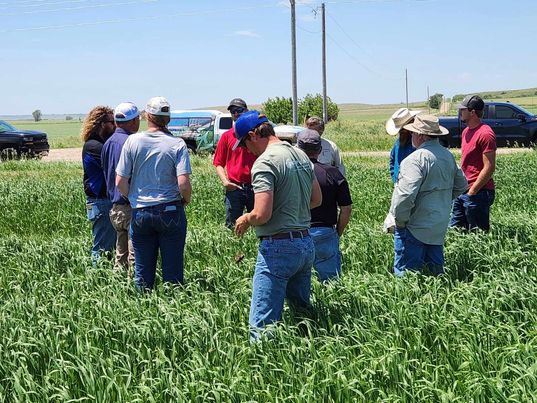
Kevin Sedivec, a professor and rangeland management specialist from North Dakota State University, gave the last presentation, “The Role of Forbs in Native Rangeland.” He discussed how producers need to learn how essential Forbs are to our ecosystem. He stated that if you have a great, diverse plant community, you have healthy soil, and in turn, healthy soil will give you a great, diverse plant community. Following lunch, the attendees traveled to field sites of annual seeded crops and native rangeland. Looking ahead, the 29th No-till on the Plains Winter Conference is scheduled for January 21st-23, 2025 in Wichita Kansas. This conference, like its predecessors, will be a platform for agricultural professionals, ranchers, and educators to learn about and discuss innovative agricultural practices.